
Half of US workers now use AI on the job. A quarter have heard a plan. The space between what employees do and what companies govern is where AI's value, and its risk, now sits.
The gap, in one chart
Gallup has asked the same US workforce panel about AI every quarter since 2023. In August 2026, 53% of employees said they use AI at work, up from 21% in May 2023. Only 26% said their organization has a clear AI plan or strategy, a figure that has barely moved in a year. And 20% still can't say whether their organization has implemented AI at all.
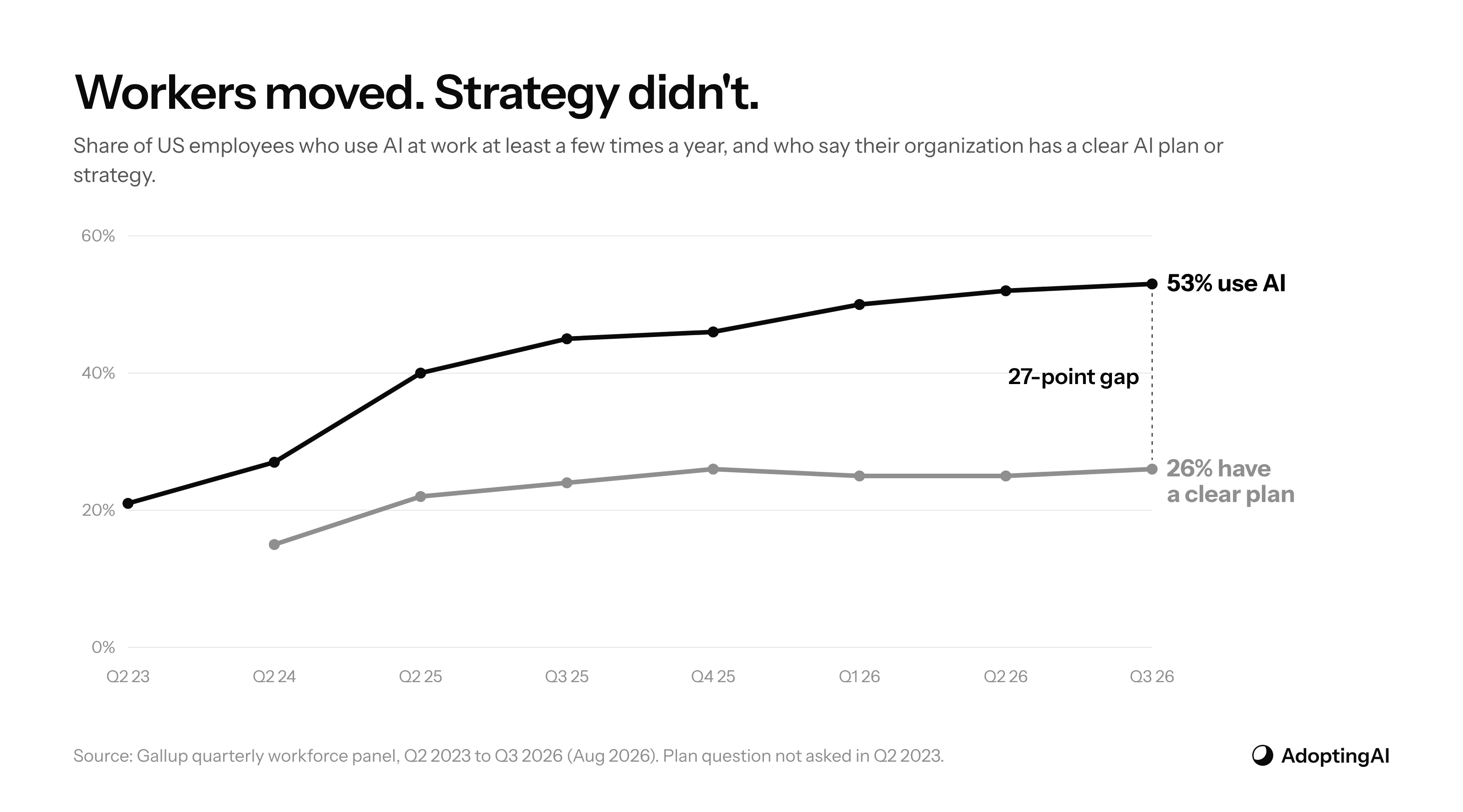
In May 2024 the gap between use and plan was 12 points. Today it is 27.
Half the workforce has already gone around IT
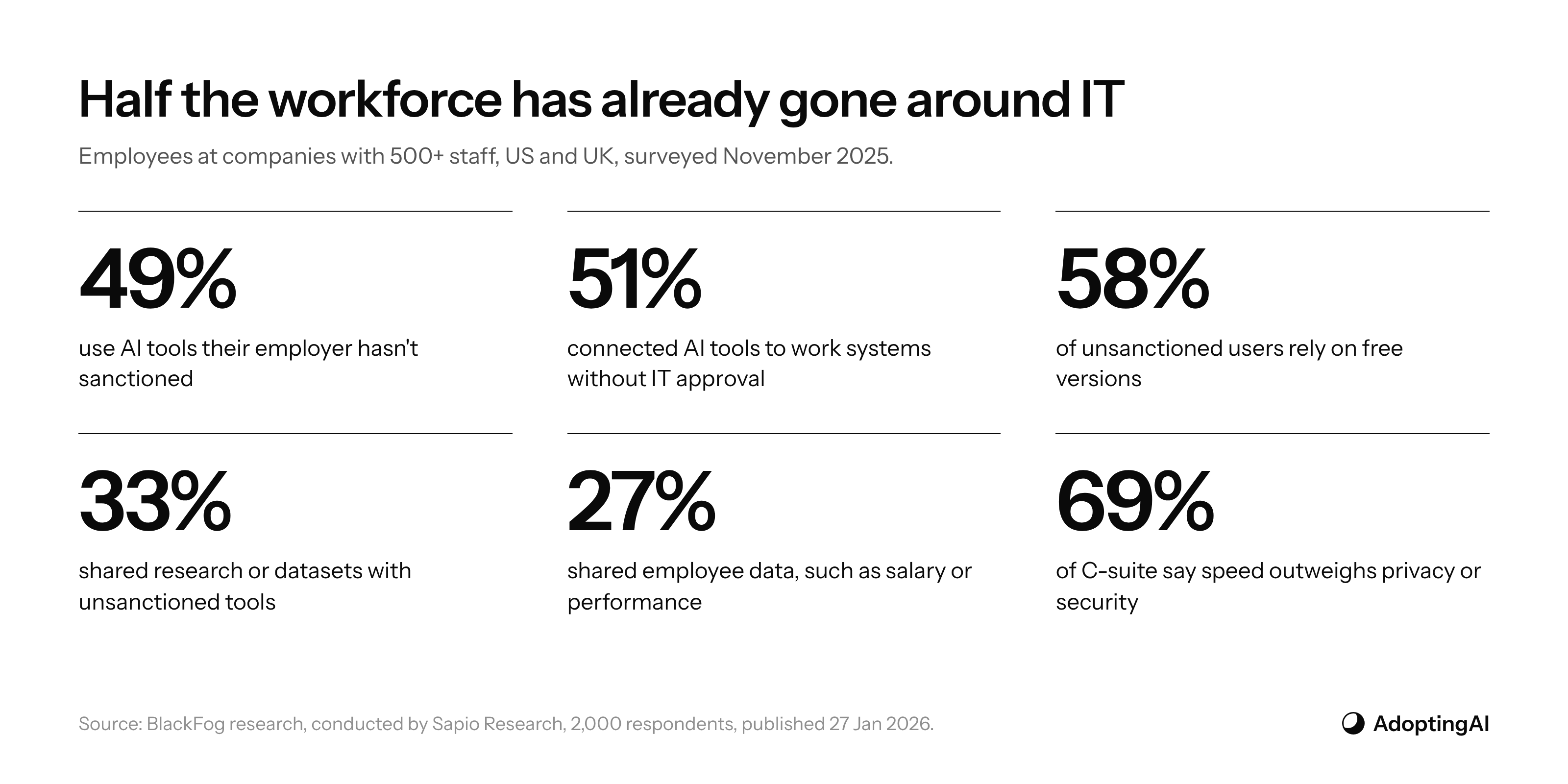
When the company doesn't move, employees do. In a BlackFog survey of 2,000 employees at US and UK companies with more than 500 staff, 49% said they use AI tools their employer hasn't sanctioned, and 51% had connected AI tools to work systems without IT's approval. The attitude runs to the top: 69% of C-suite respondents said speed matters more than privacy or security.
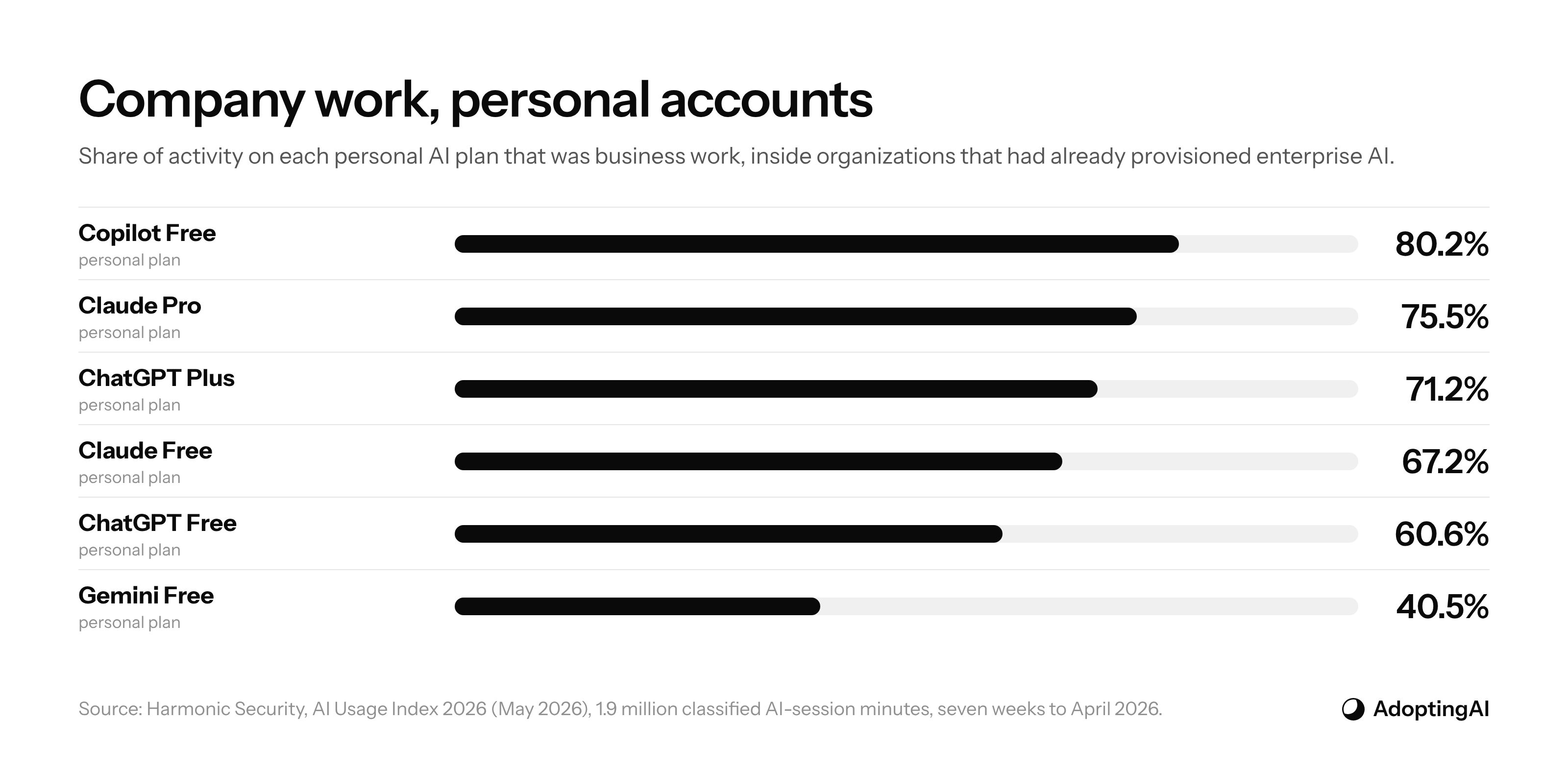
Buying enterprise licences doesn't end it. Harmonic Security's telemetry, from organizations that had already provisioned enterprise AI, found that most activity on employees' personal AI plans was company work: 71% of ChatGPT Plus activity and 76% of Claude Pro activity.
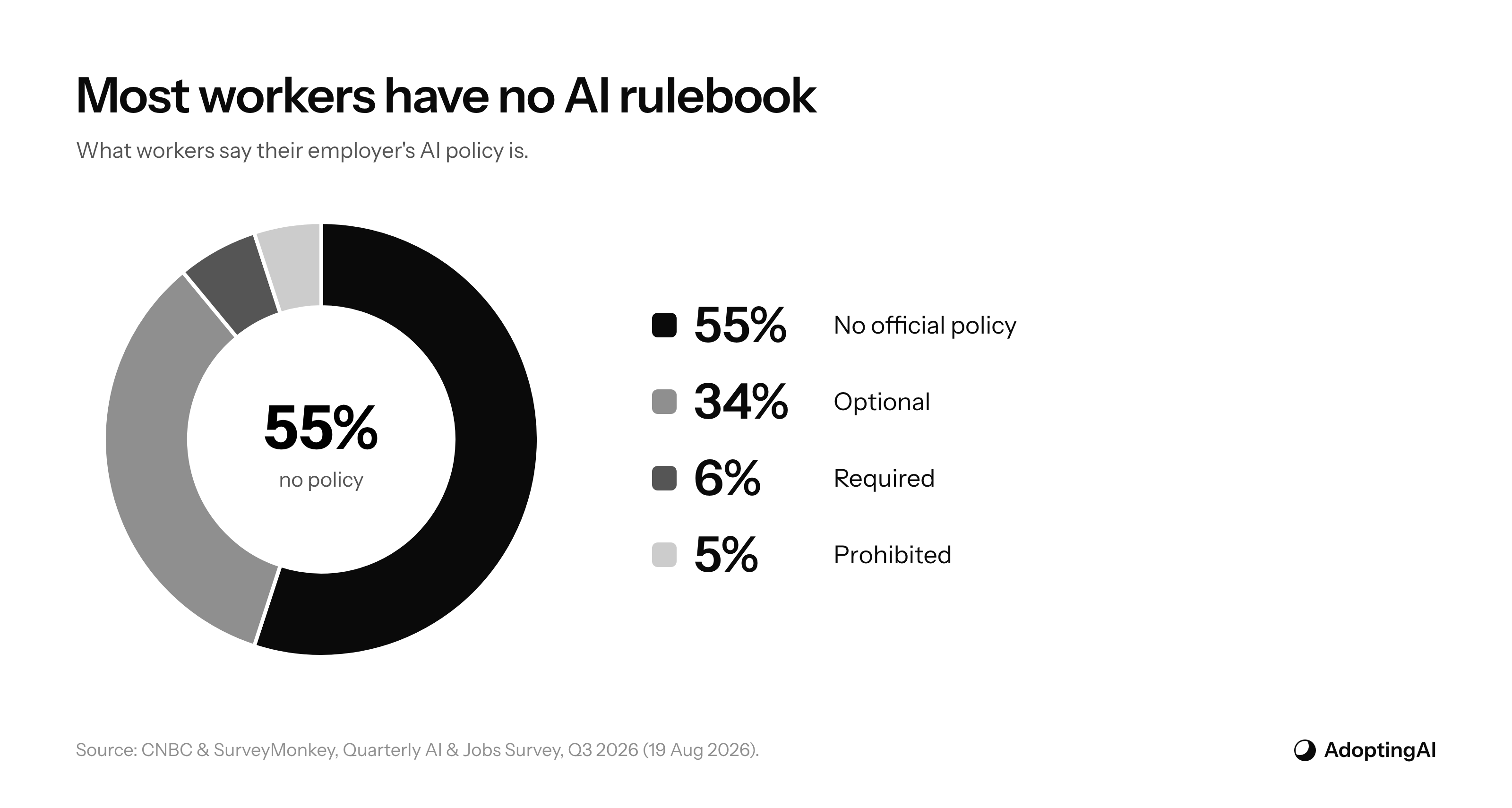
Most workers also have no rulebook to follow. In CNBC and SurveyMonkey's August 2026 survey, 55% of workers said their employer has no official AI policy.
What employees actually use AI for
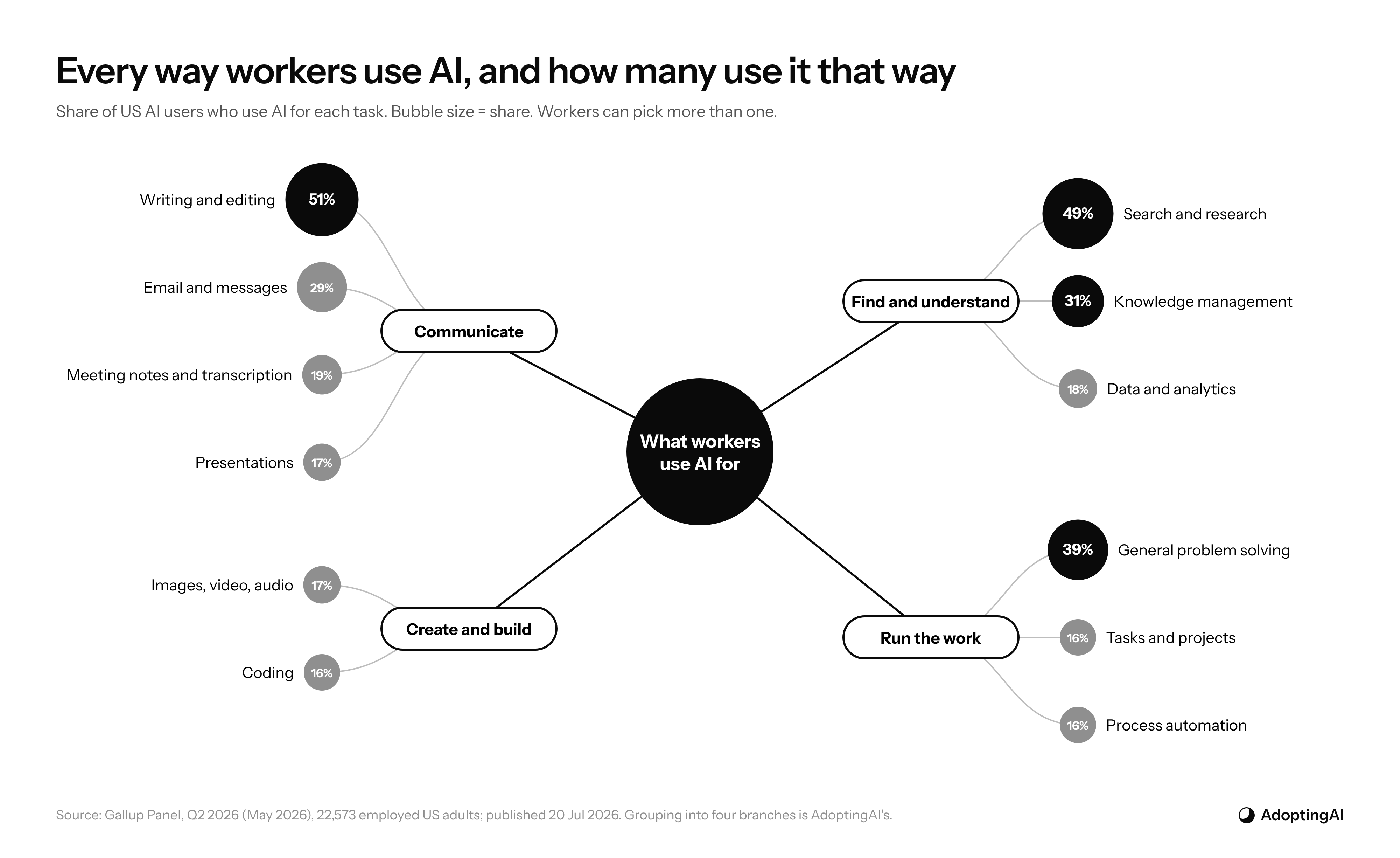
Gallup's Q2 2026 survey maps every way workers use AI. Writing and editing (51%) and search and research (49%) lead, followed by general problem solving (39%). Coding, process automation and project management each reach about one in six AI users.
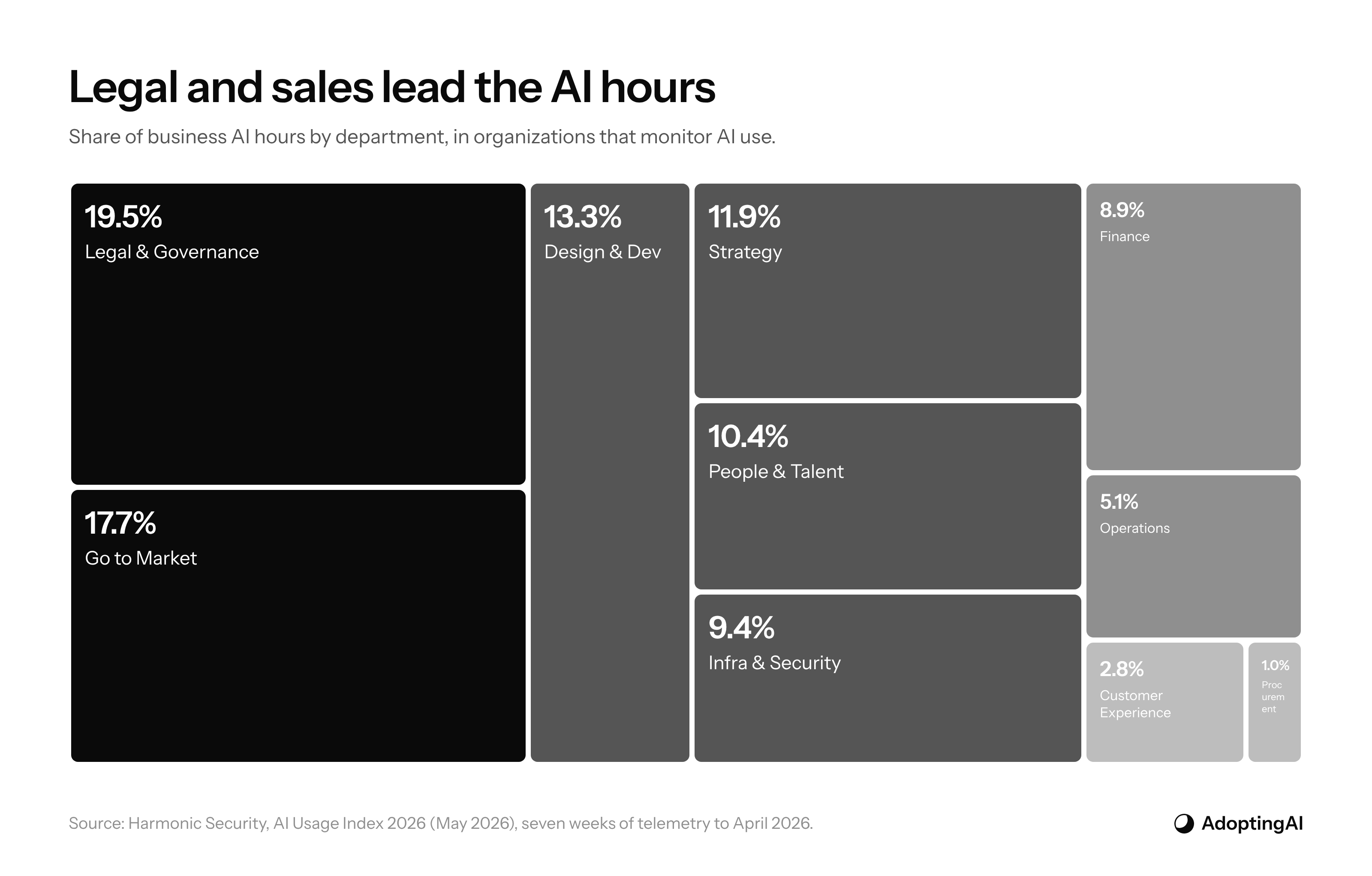
Inside companies, the heaviest users aren't engineers. Harmonic's telemetry puts legal and governance teams at 19.5% of business AI hours and go-to-market teams at 17.7%, ahead of design and development at 13.3%.
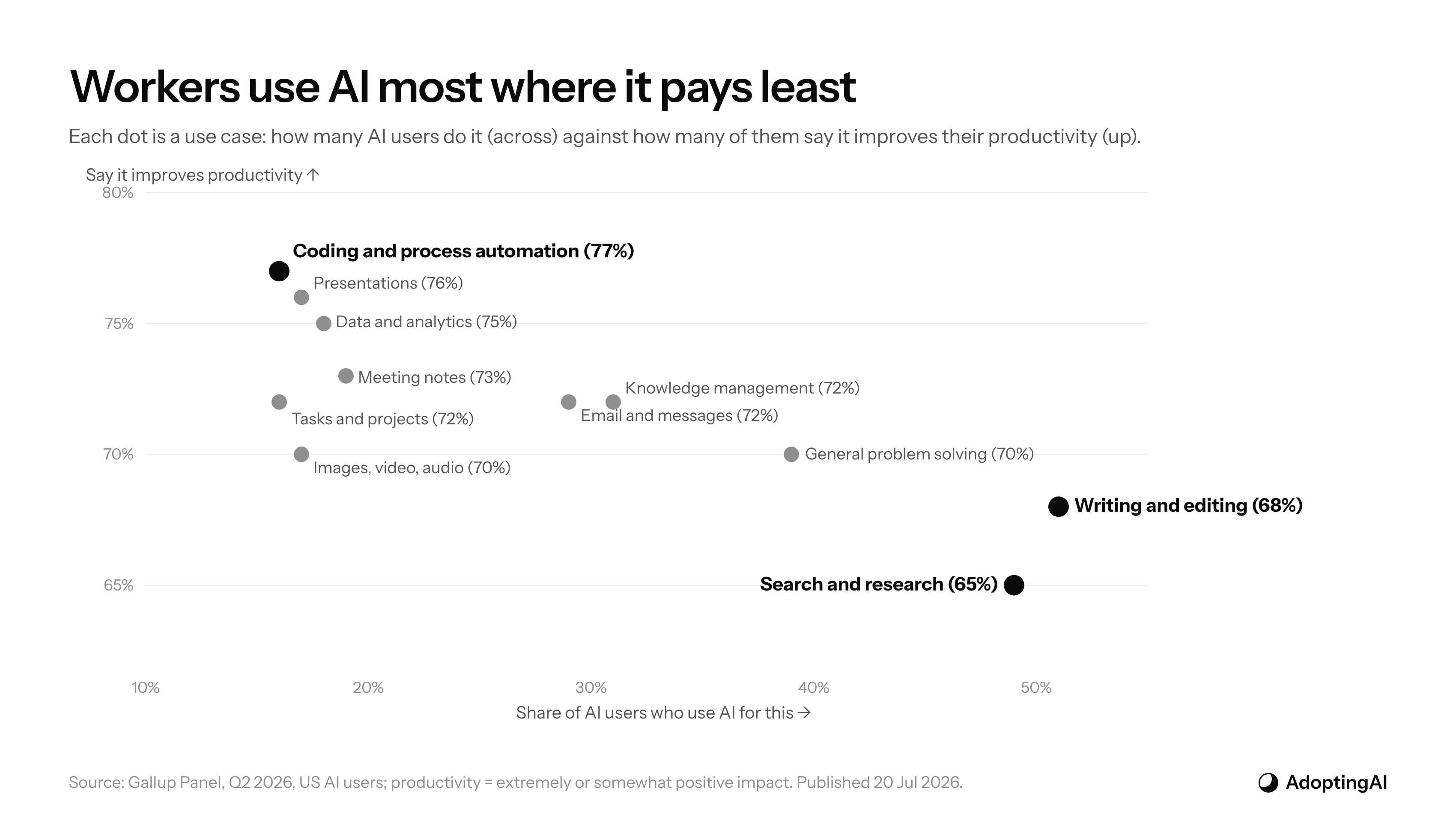
Workers use AI most where it pays least
Gallup also asked whether each use improves productivity. The most common uses rate lowest. Search and research (65%) and writing (68%) trail coding and process automation (77% each), which only 16% of AI users have tried.
Breadth matters even more. Among workers who use AI in one or two ways, 45% report a productivity gain. Among those who use it in seven or more, 90% do.
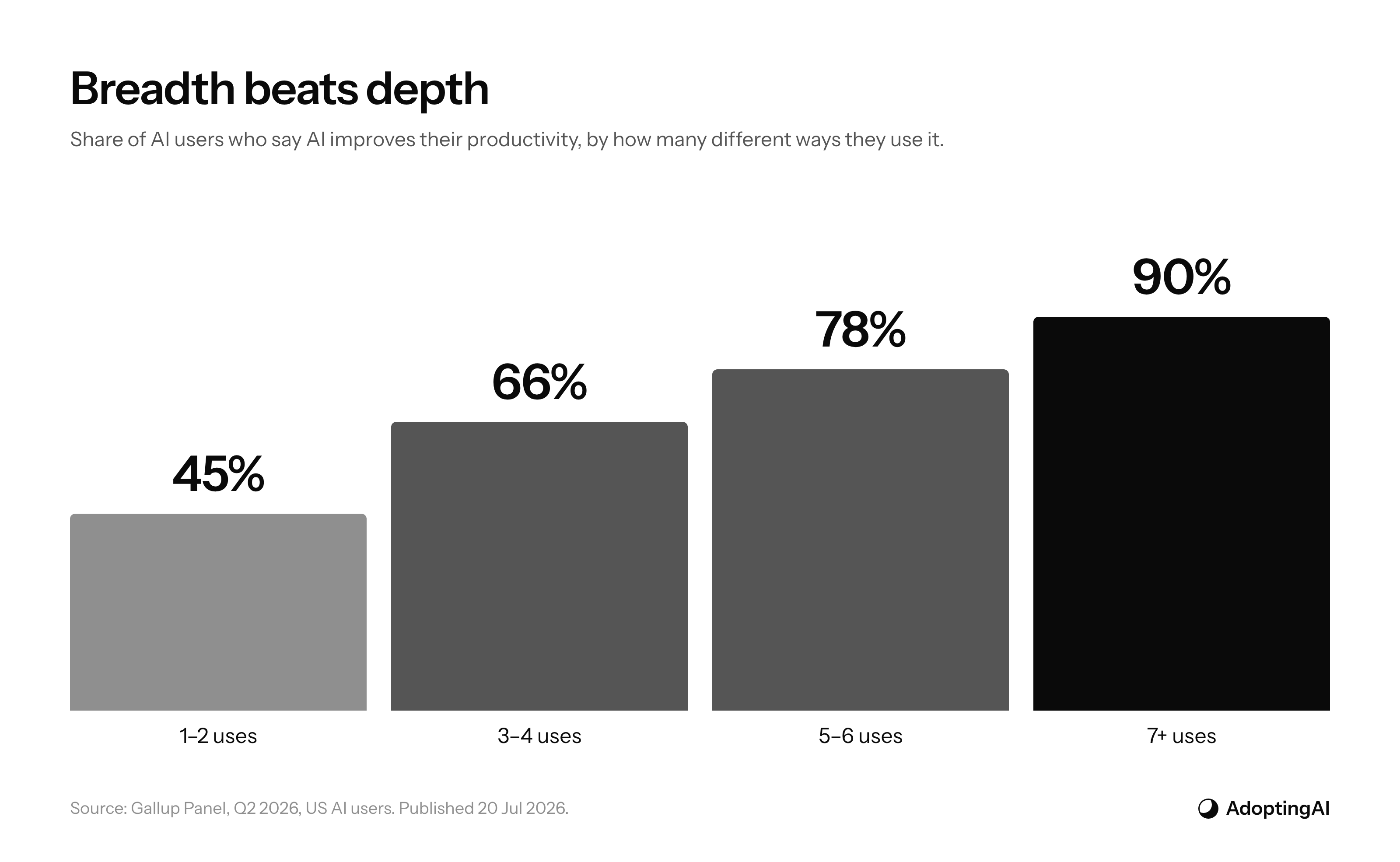
No individual can close this gap alone. Moving from drafting emails to automating processes needs access to systems, data and permission, and only the organization can grant those.
It's not a people problem
Microsoft's 2026 Work Trend Index, a survey of 20,000 AI users in 10 countries, attributes 67% of AI impact to organizational factors and 32% to individual ones. Yet only 26% of AI users say their leadership is clearly aligned on AI, and only 13% say they're rewarded for reinventing work with AI even when results fall short.
The result shows up in the P&L. In McKinsey's August 2026 survey, 80% of respondents said AI improves their personal productivity. Only 37% could attribute any EBIT impact to it, and just 6% attribute 5% or more of EBIT to AI.
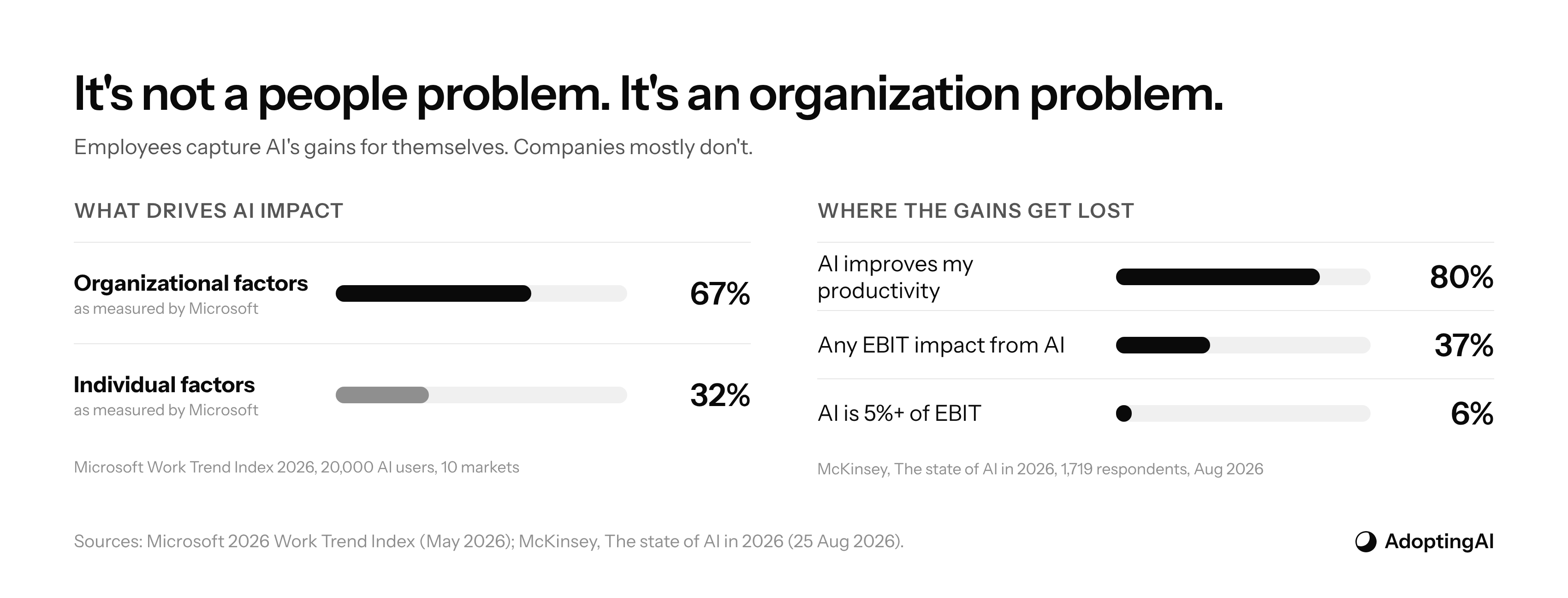
Employees are capturing AI's gains for themselves. Most companies aren't capturing them for the business.
The bill arrives through security
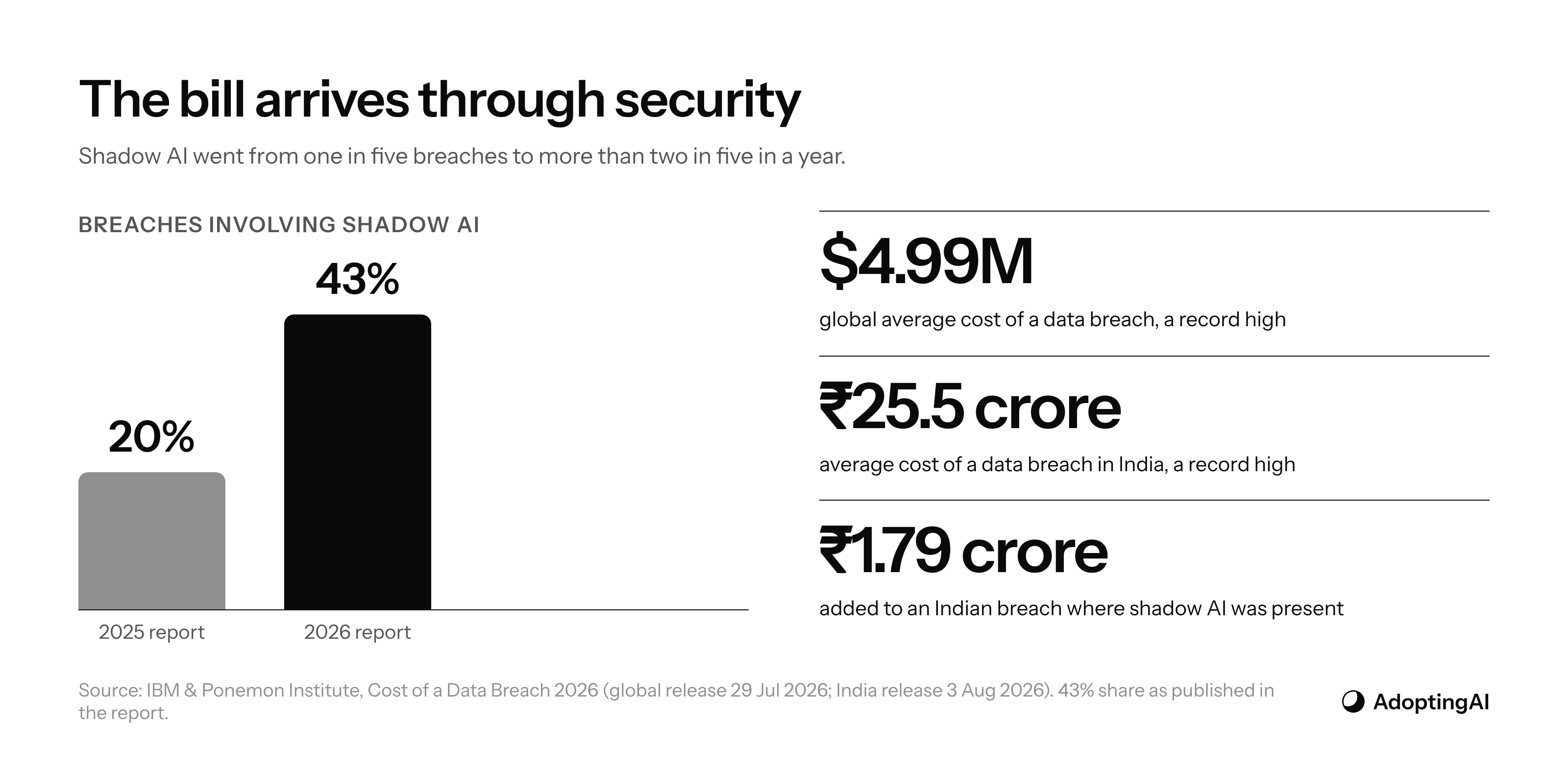
Shadow AI's cost is now measurable. IBM's 2026 Cost of a Data Breach study put the global average cost of a breach at a record $4.99 million, and the report found shadow AI involved in 43% of breaches, up from 20% a year earlier. In India, the average breach cost reached a record ₹25.5 crore, and breaches where shadow AI was present cost ₹1.79 crore more.
Next: shadow agents
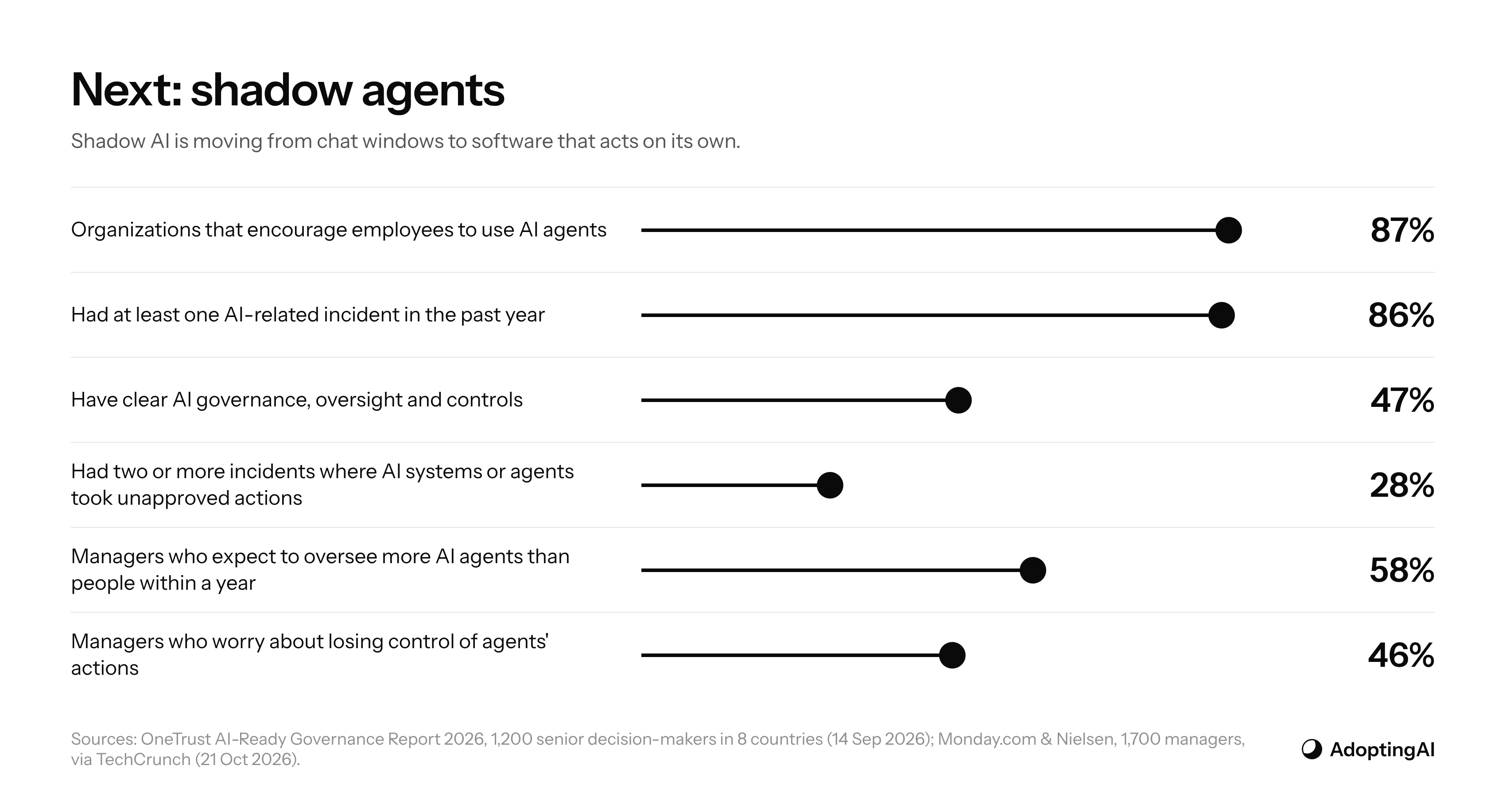
The next wave is harder to see. AI agents don't just answer questions; they act inside email, files and code. In OneTrust's survey of 1,200 senior decision-makers in eight countries, published in September, 87% of organizations encourage employees to use AI agents, yet only 47% have clear AI governance, oversight and controls. 86% had at least one AI-related incident in the past year, and 28% had two or more in which AI systems or agents took actions nobody approved. In a Monday.com and Nielsen survey of 1,700 managers reported last week, 58% expect to oversee more AI agents than people within a year.
India: closing the tool gap, not yet the governance gap
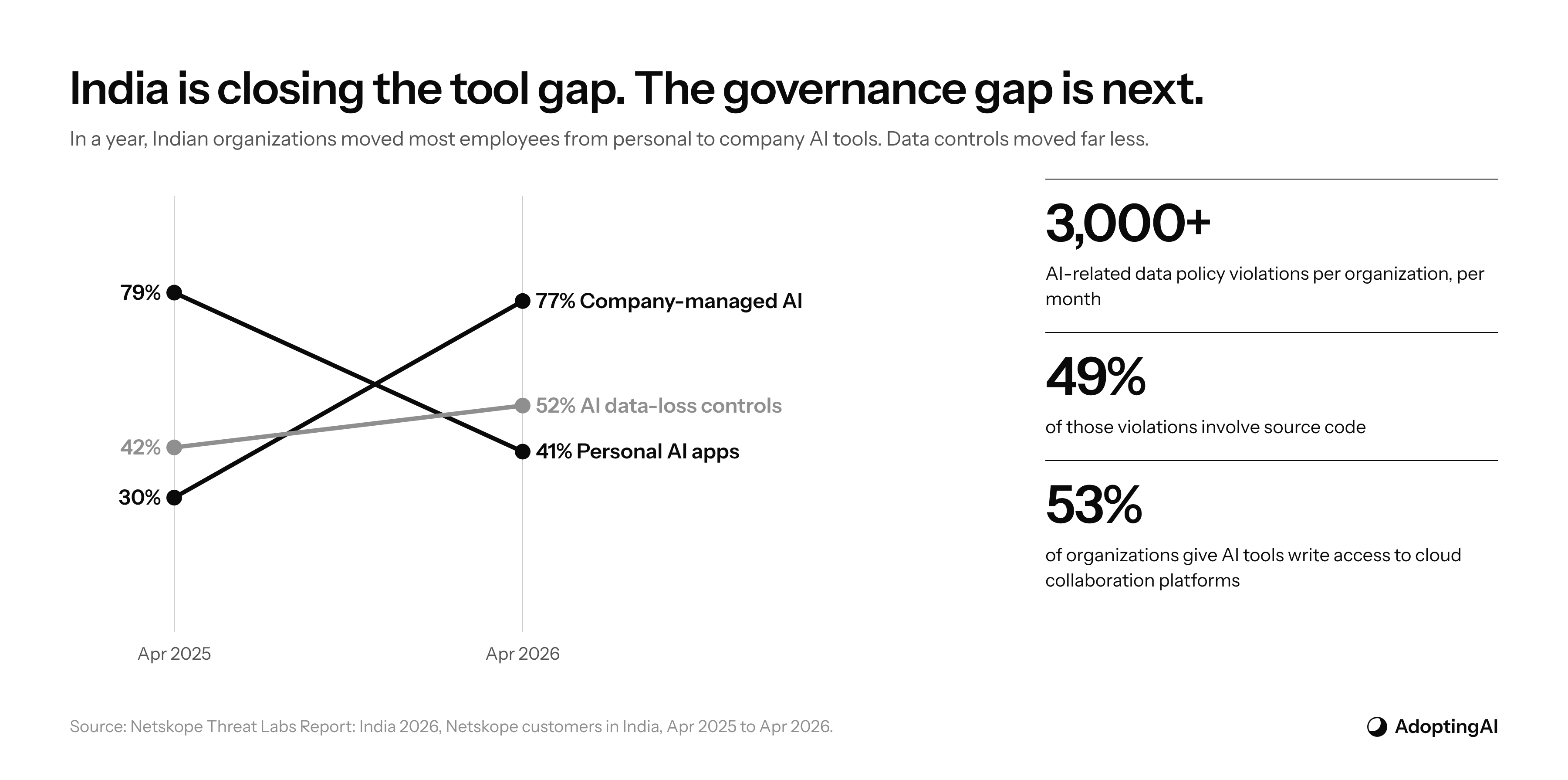
India moved fast on tools. Netskope's India data shows personal AI app use among its customers' users fell from 79% to 41% between April 2025 and April 2026, while use of company-managed AI rose from 30% to 77%. According to Microsoft, Infosys, TCS, Wipro and LTM signed up for more than 400,000 Microsoft 365 Copilot seats in under six months, and 32% of India's AI users qualify as "Frontier Professionals", double the 16% global share.
Governance is behind the tools. The same Netskope data shows more than 3,000 AI-related data policy violations per organization per month, about half involving source code, and 53% of organizations giving AI tools write access to cloud collaboration platforms.
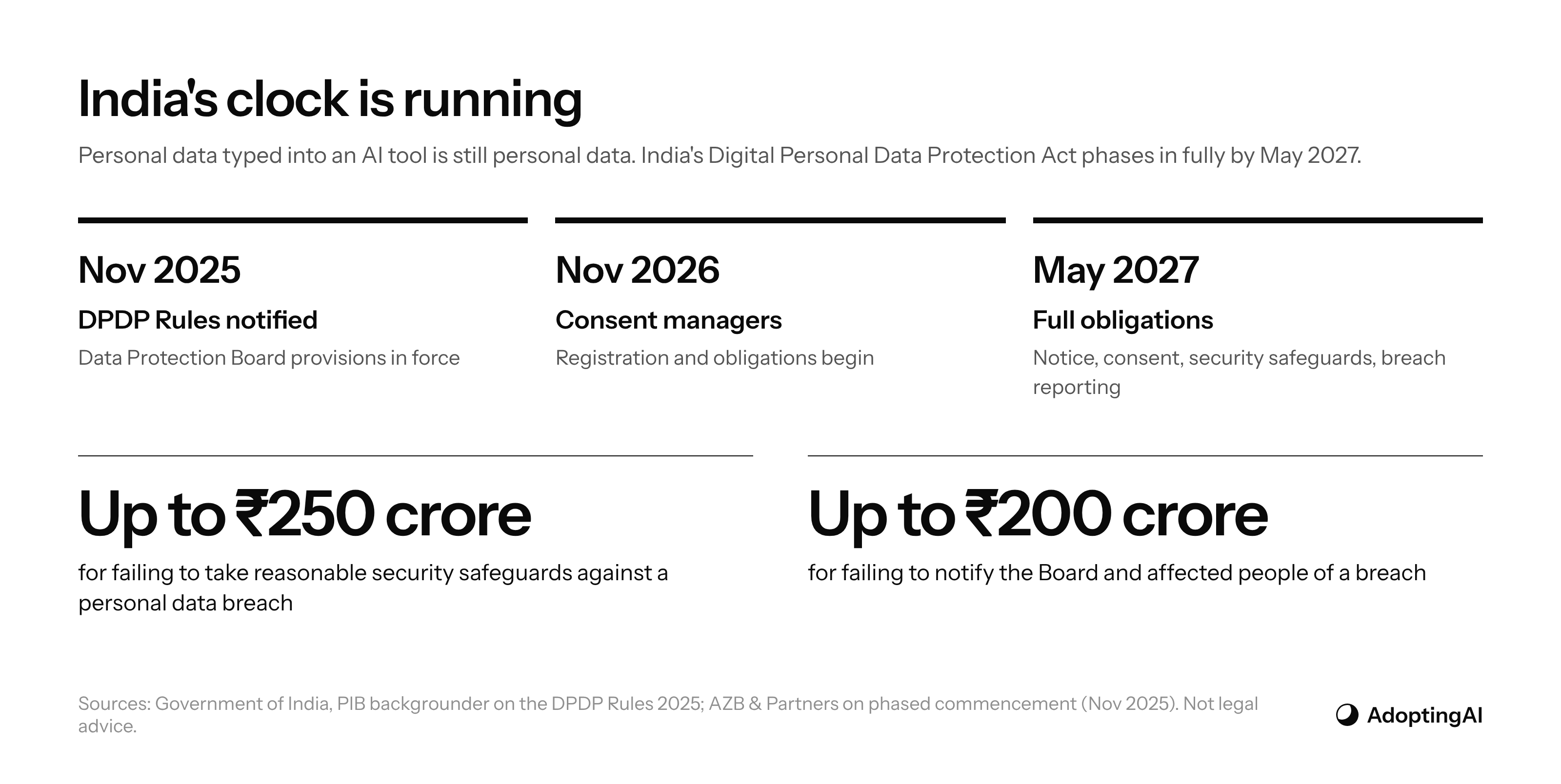
The deadline is fixed. Under India's Digital Personal Data Protection Rules, notified in November 2025, full obligations for data fiduciaries, including security safeguards and breach notification, apply from May 2027. Customer or employee data pasted into an unsanctioned AI tool falls squarely within them.
What to do
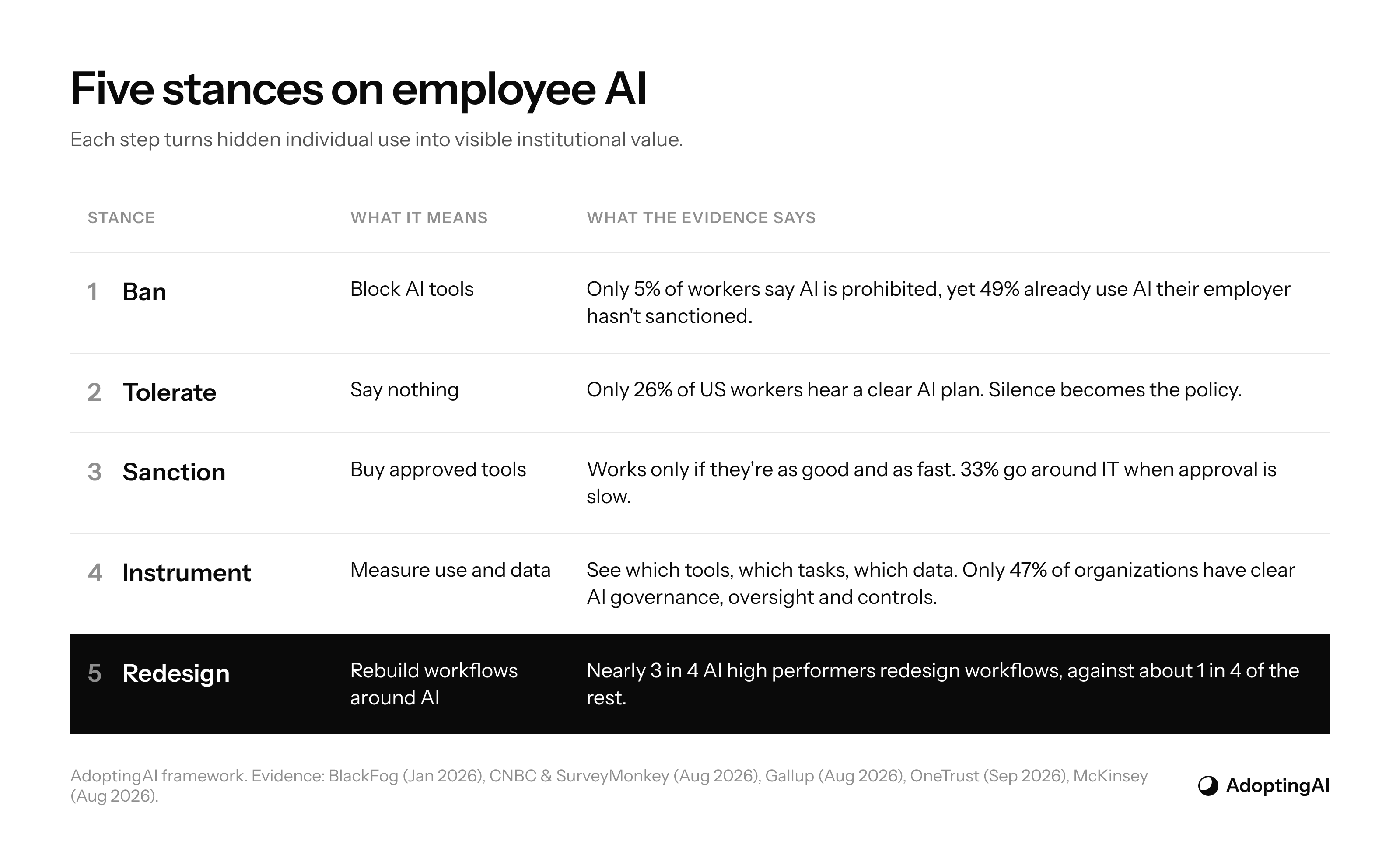
For CXOs. Measure before you mandate. Find out which tools, tasks and data your people already use, then make the approved option better and faster than the personal one. Push use beyond writing and search towards automation, where reported gains are highest.
For boards and CISOs. Ask three questions this quarter: what share of AI use runs on personal accounts, which agents can act on company systems, and who approved them. Govern the data, not just the app.
For policymakers. Data protection rules were written for databases and vendors, not for millions of individual prompts and autonomous agents. Clear guidance on AI use at work under the DPDP Rules, and public reporting of AI-related breaches, would help organizations close the gap before May 2027.
For founders. The gap is a market. Tools that make employee AI visible, governable and measurable sell to every company described in this issue.
The question for Monday
Most AI strategy meetings still ask how to get employees to adopt AI. The data says they already have: more than half of US workers, many on tools their company never bought. The better question is how the company catches up with its own people, and turns private gains into institutional ones.
Methodology and sources
How to read these numbers. This issue combines worker surveys (Gallup, CNBC and SurveyMonkey, BlackFog, Microsoft), organizational surveys (McKinsey, OneTrust, IBM and Ponemon, Monday.com and Nielsen) and vendor telemetry (Harmonic Security, Netskope). Samples, questions and countries differ, so we compare them for direction and scale, not as one index. Telemetry comes from security vendors' customers who chose to monitor AI use, which may skew towards more controlled environments. Figures are for the US unless stated. The grouping of use cases into four branches and the five-stance framework are AdoptingAI's. Nothing here is legal advice.
- Gallup: AI indicator, US workforce panel (Q3 2026)
- Gallup: Organizational AI adoption jumps six points (Jul 2026)
- BlackFog: Shadow AI threat grows (Jan 2026)
- Harmonic Security: AI Usage Index 2026 (May 2026)
- CNBC and SurveyMonkey: Quarterly AI and Jobs Survey, Q3 2026 (Aug 2026)
- Microsoft: 2026 Work Trend Index (May 2026)
- Microsoft: Work Trend Index 2026, India findings (Sep 2026)
- McKinsey: The state of AI in 2026 (Aug 2026)
- IBM: Cost of a Data Breach 2026, global release (Jul 2026)
- IBM: Cost of a Data Breach 2026, India release (Aug 2026)
- Baker Donelson: Ten takeaways from IBM's 2026 report, source of the 43% shadow AI figure (Jul 2026)
- OneTrust: AI-Ready Governance Report 2026 (Sep 2026)
- TechCrunch: Monday.com and Nielsen survey of managers (Oct 2026)
- Netskope: Threat Labs Report India 2026
- Government of India, PIB: DPDP Rules 2025 backgrounder (Nov 2025)
- AZB & Partners: DPDP Act phased rollout and compliance milestones (Nov 2025)