
Most coverage says chatbots are killing Google Search. The numbers tell a more complicated story: Alphabet's AI business is booming, its search growth is slowing, and building AI now costs more cash than the whole company generates.
$1.2 billion a minute
On Thursday, 29 October 2026, Alphabet, Google's parent company, lost about $475 billion in market value. Averaged over the 6.5-hour trading session, that is $1.2 billion a minute.
In one session, Google's parent lost more than the entire market value of Coca-Cola. It lost almost two Netflixes. It lost Netflix and Disney combined, with $22 billion to spare. It lost nearly three times the value of Reliance Industries, India's most valuable company. And it lost more than five times India's entire defence budget for 2026–27.
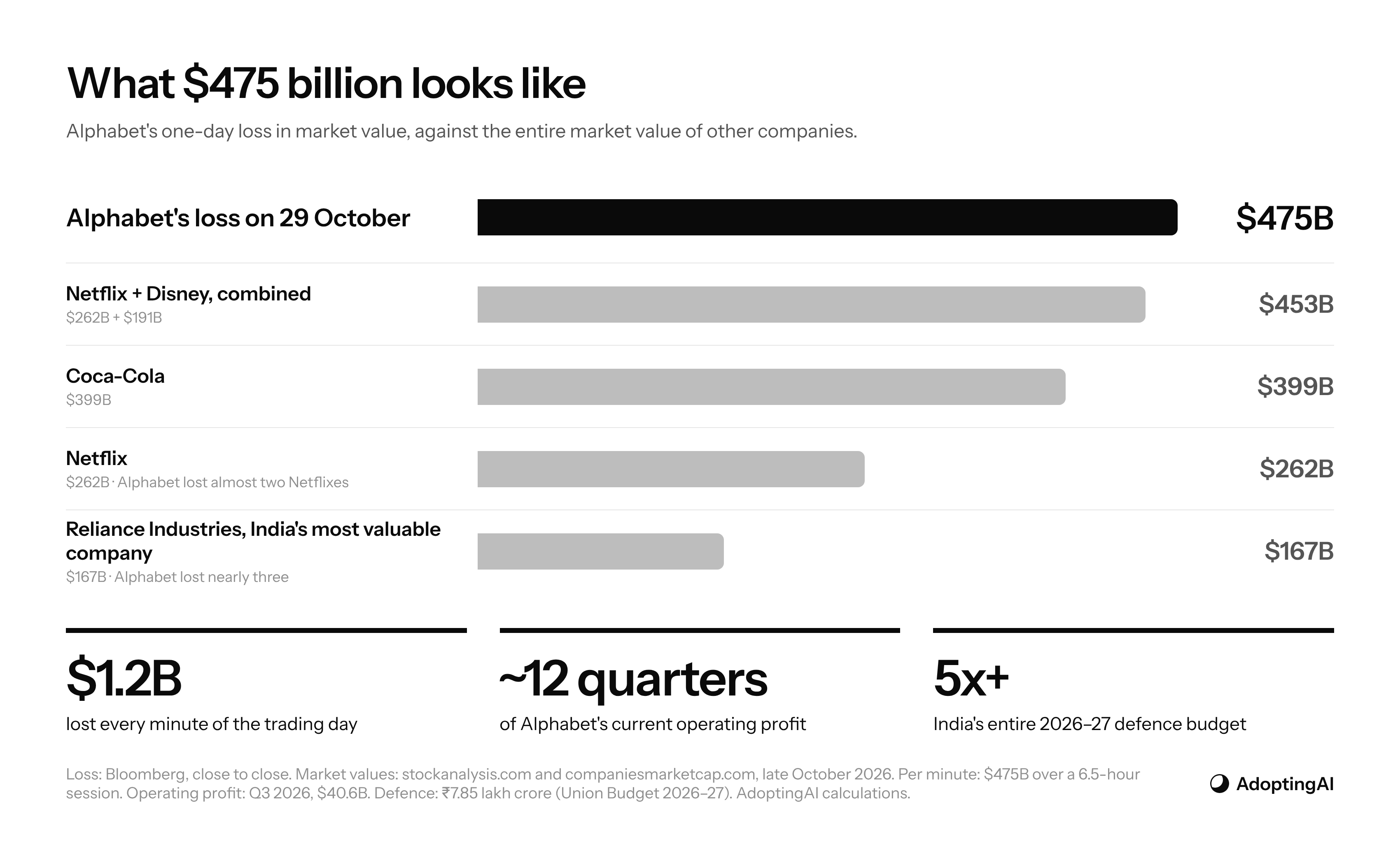
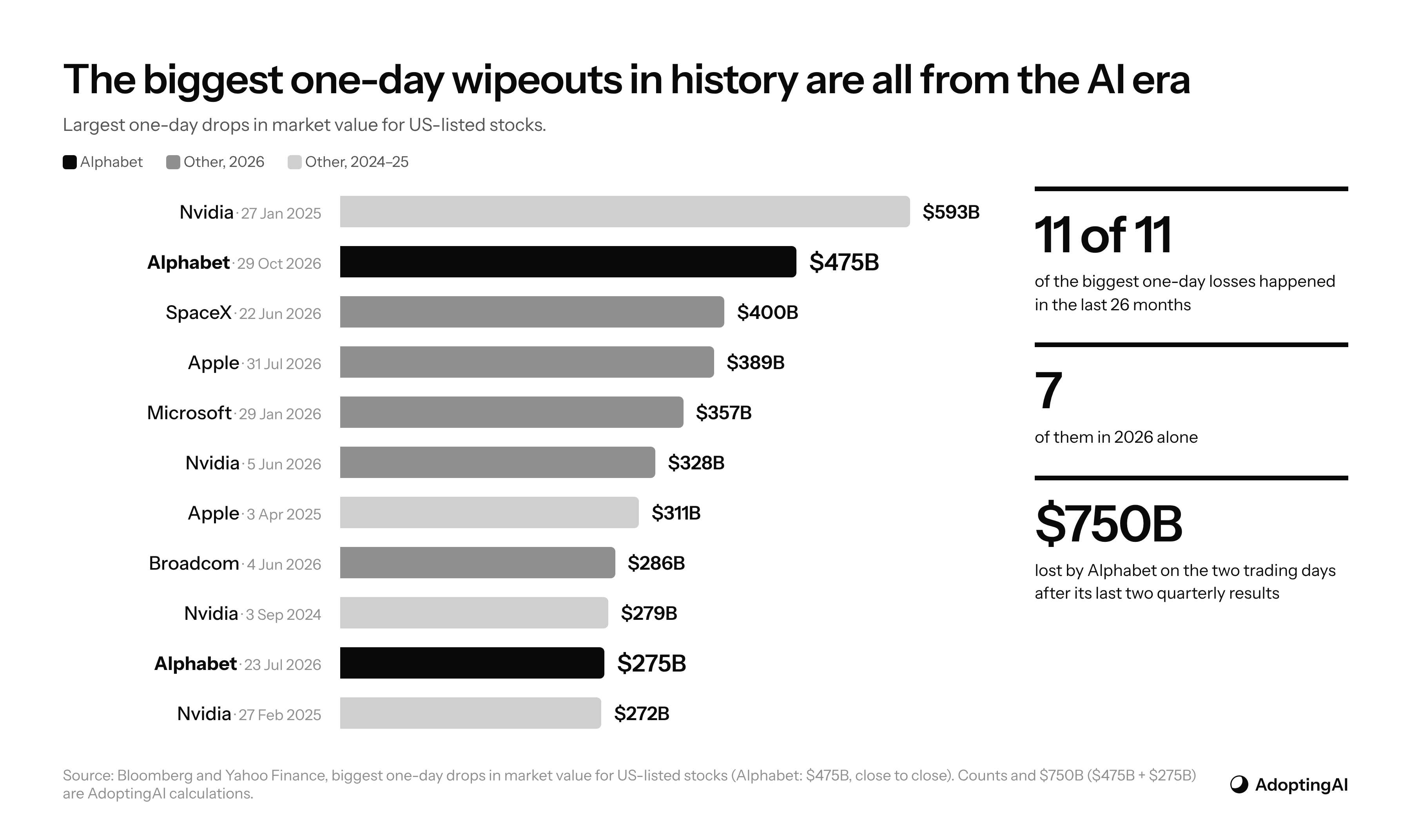
The shares fell nearly 13% (CNBC), Alphabet's worst day since it listed in 2004. Among US-listed stocks, only one has ever lost more in a single day: Nvidia, which lost about $593 billion in January 2025 (Bloomberg, via Yahoo Finance).
That leaderboard is a story in itself. In Bloomberg's ranking, all 11 of the largest one-day drops in market value for US-listed stocks happened between September 2024 and October 2026, at just six companies: Nvidia, Alphabet, Apple, Microsoft, Broadcom and SpaceX. Seven came in 2026 alone. Alphabet appears twice: on 23 July, after its previous quarterly results, it lost $275 billion. Across those two post-results sessions, three months apart, it lost about $750 billion.
The strange part is the timing. By most measures of AI progress, this was one of Alphabet's strongest quarters yet.
Everything about the AI worked
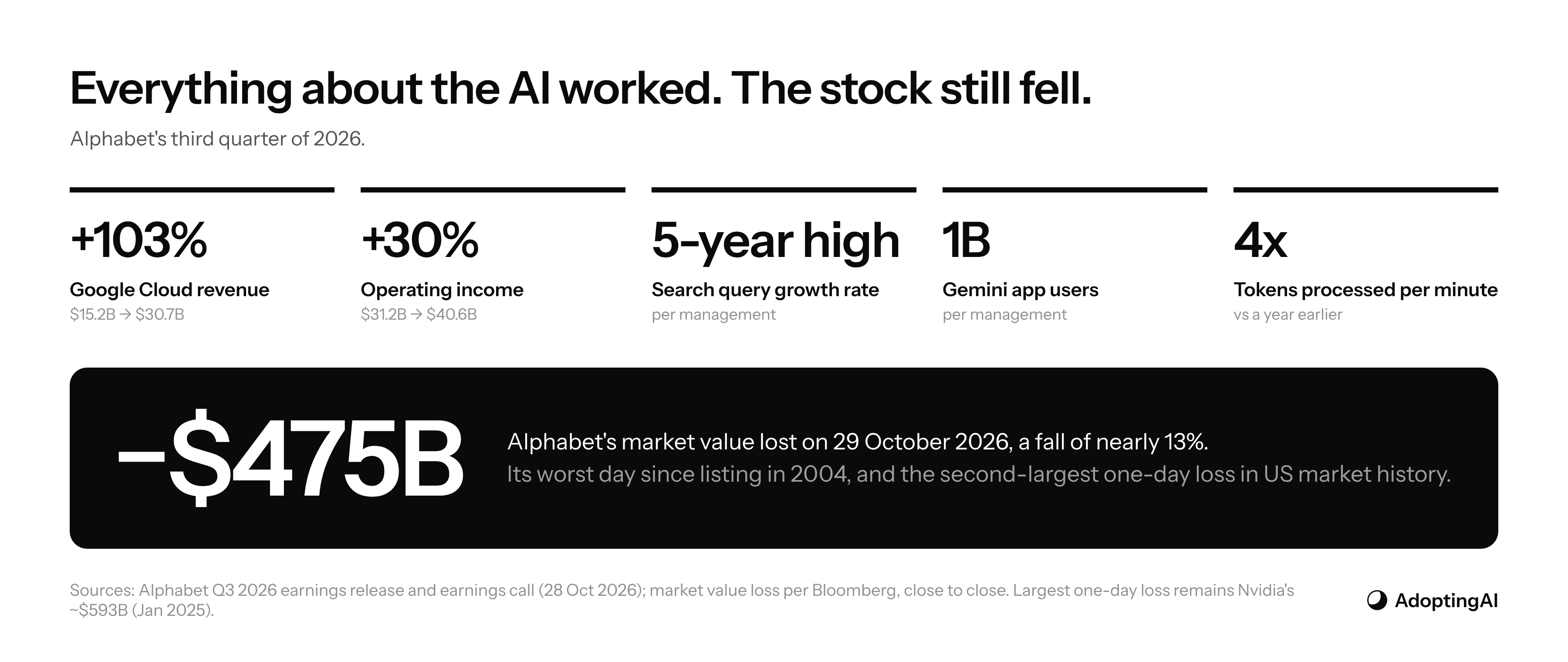
By almost every measure of AI progress, Alphabet had a strong quarter (Q3 2026 earnings release):
- Google Cloud revenue doubled, up 103% to $30.7 billion. Its operating income tripled to $11.1 billion.
- Operating income rose 30% to $40.6 billion, on revenue of $127.6 billion.
- Search queries grew at their fastest rate in five years, according to CEO Sundar Pichai.
- The Gemini app reached 1 billion users, and Google's first-party models now process nearly 32 billion tokens a minute through its APIs, more than 4x a year earlier (earnings call).
Earnings per share did miss: $2.12, against expectations of nearly $3 (XTB). But an $8.7 billion paper loss on equity investments, which the CFO tied mainly to Alphabet's stake in SpaceX, cut EPS by $0.55. That loss is unrelated to AI or search.
So what did investors see? Two things: what AI is doing to search revenue growth, and what it is doing to Alphabet's cash.
1. More questions, less money
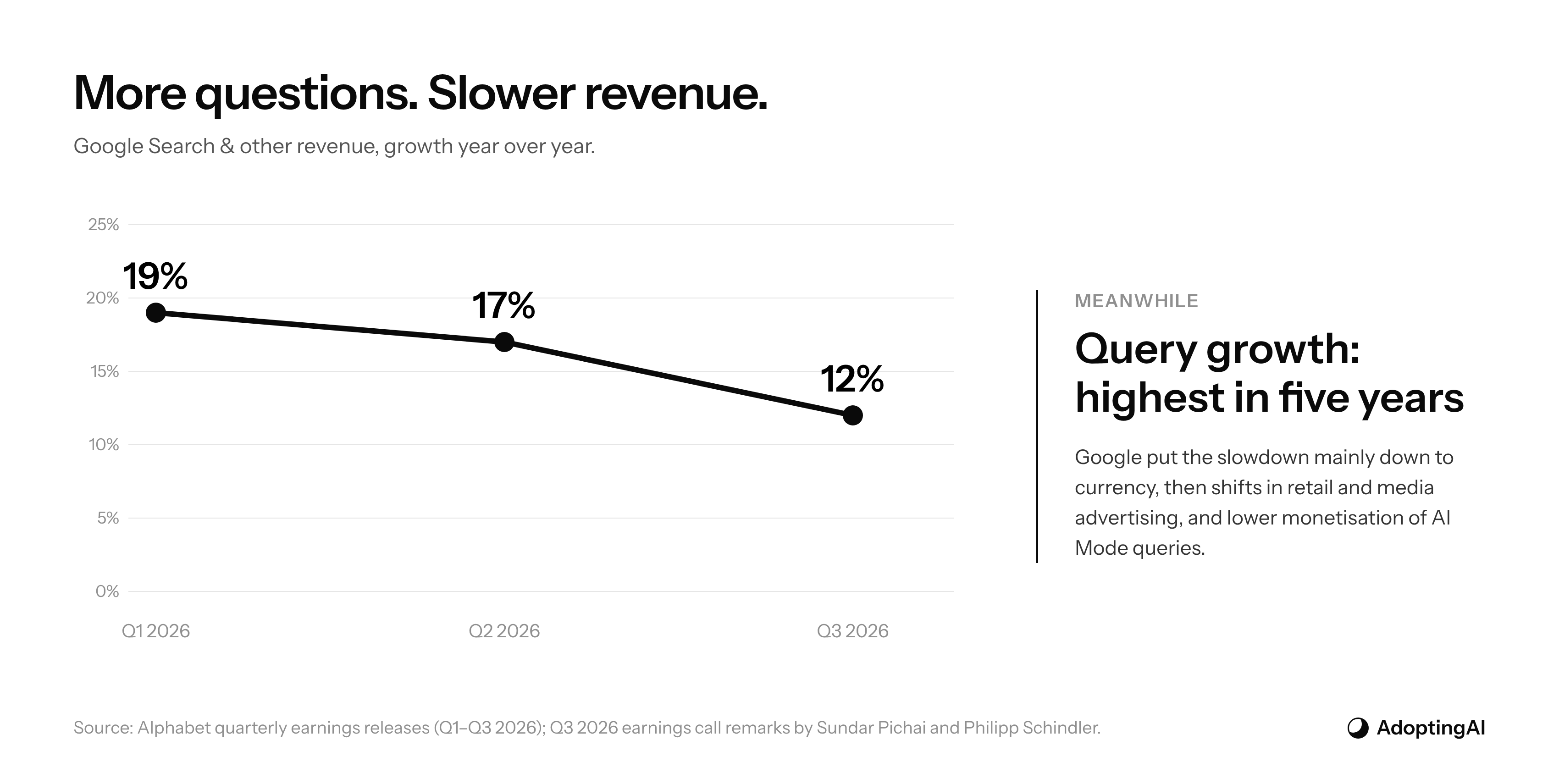
Search revenue grew 19% in the first quarter of 2026, 17% in the second and 12% in the third, to $63.4 billion. Over the same period, according to Google, search query growth reached its fastest pace in five years.
Query growth sped up while revenue growth slowed. Google does not publish query volumes, so revenue per query cannot be calculated. Asked about the slowdown, chief business officer Philipp Schindler named currency moves as the main factor, followed by shifts in advertiser categories: retail in Asia-Pacific, and media after an unusually strong second quarter. He also said "the strong growth in AI Mode queries had an impact", because AI Mode currently earns less, and that Google is scaling ads across AI Overviews and AI Mode (earnings call).
AI Mode queries are about three times longer than ordinary searches, and Google says most of them are additional searches rather than replacements. But ad formats for these longer, conversational answers are still being built. Until they earn as much as a classic results page, more AI usage can mean slower search revenue growth.
Until now, the claim that AI answers would weigh on search revenue was mostly a forecast. This quarter, Google named it as one factor in its search slowdown, though not the main one.
2. Google now spends more cash than it makes
The bigger shift is in the cash flow statement. A year ago, Alphabet generated $48.4 billion in cash from operations in a quarter and spent $24.0 billion on capital expenditure, mostly data centres and chips. This quarter it generated $42.3 billion and spent $51.4 billion.
That left free cash flow at minus $9.1 billion, after minus $5.9 billion in the second quarter. Bloomberg reports these are Alphabet's first back-to-back negative quarters since it listed in 2004. Operating income rose 30%, yet operating cash flow fell 13%. On the call, the CFO also noted that selling Google's TPU chip systems to customers creates a different cash cycle: Alphabet builds the systems as inventory after contracts are signed and is paid on delivery.
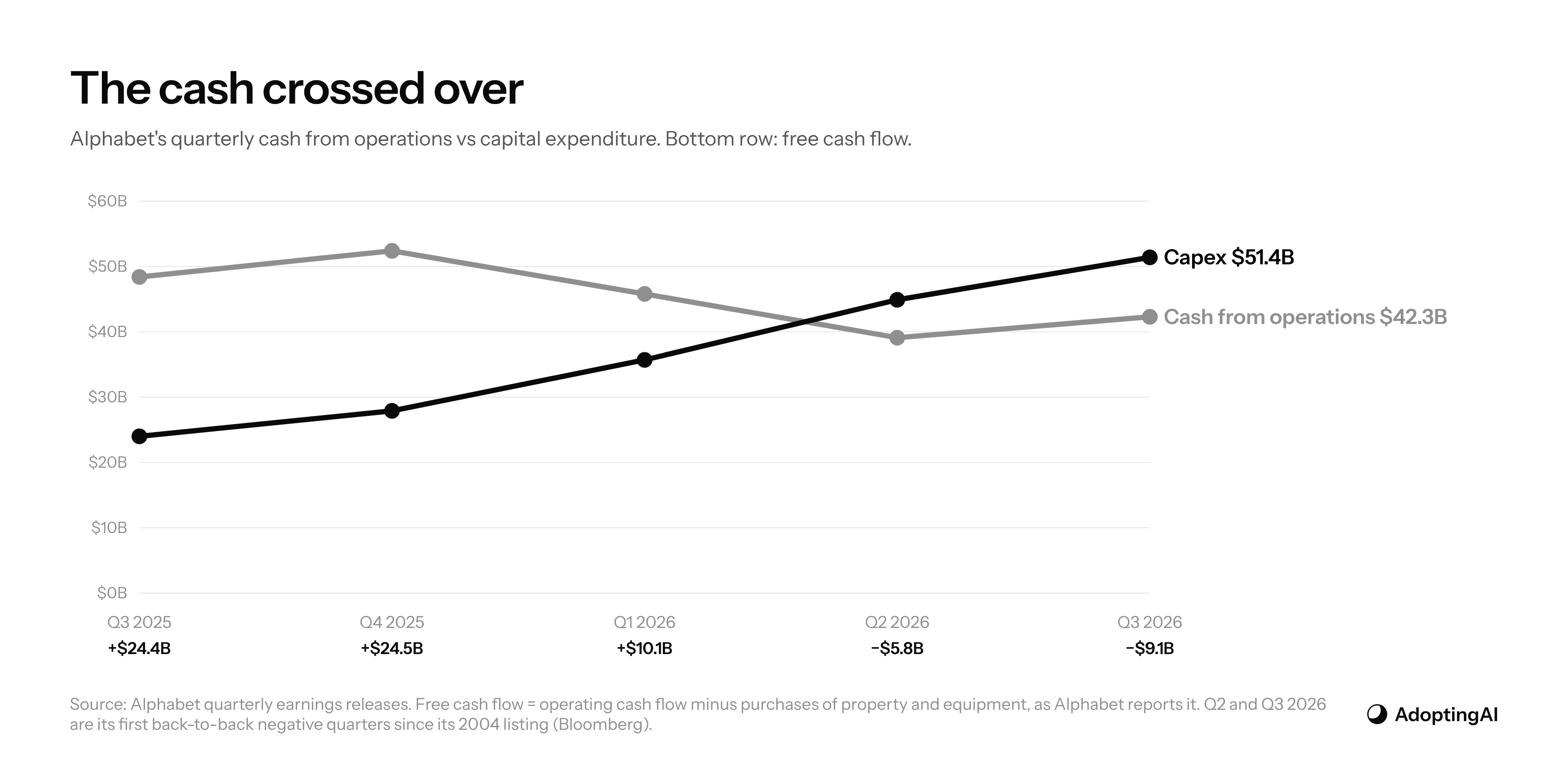
It will get bigger. Alphabet kept its 2026 capex guidance at $195–205 billion, which implies up to $73 billion in the fourth quarter alone. CFO Anat Ashkenazi said capex will "increase significantly in 2027".
Alphabet is not alone. Meta, also funded mainly by advertising, spent more than it generated: free cash flow was minus $2.1 billion in the same quarter (Meta Q3 2026 results). Microsoft, funded mainly by enterprise software and cloud, generated $58.0 billion in operating cash and spent $39.4 billion on capex in its latest quarter, leaving $18.6 billion (Microsoft FY27 Q1 results).
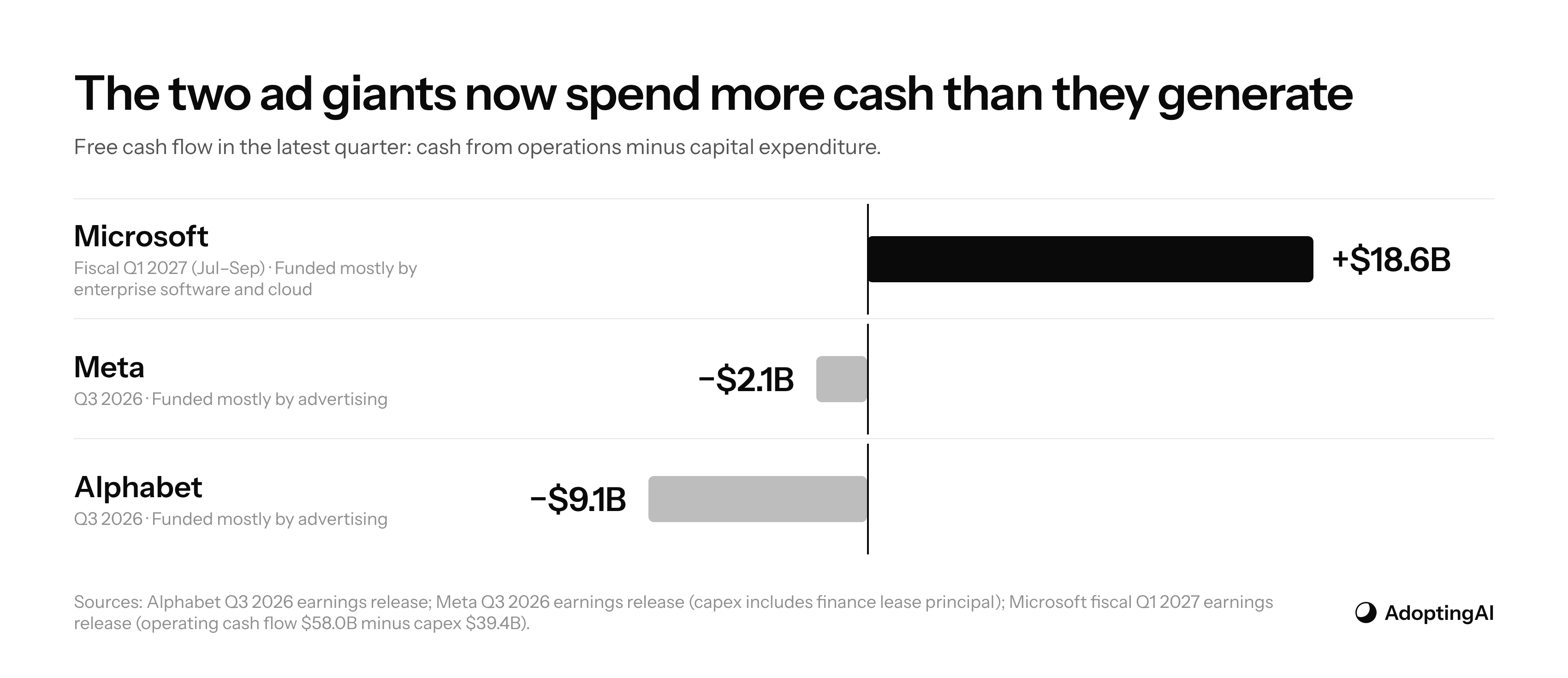
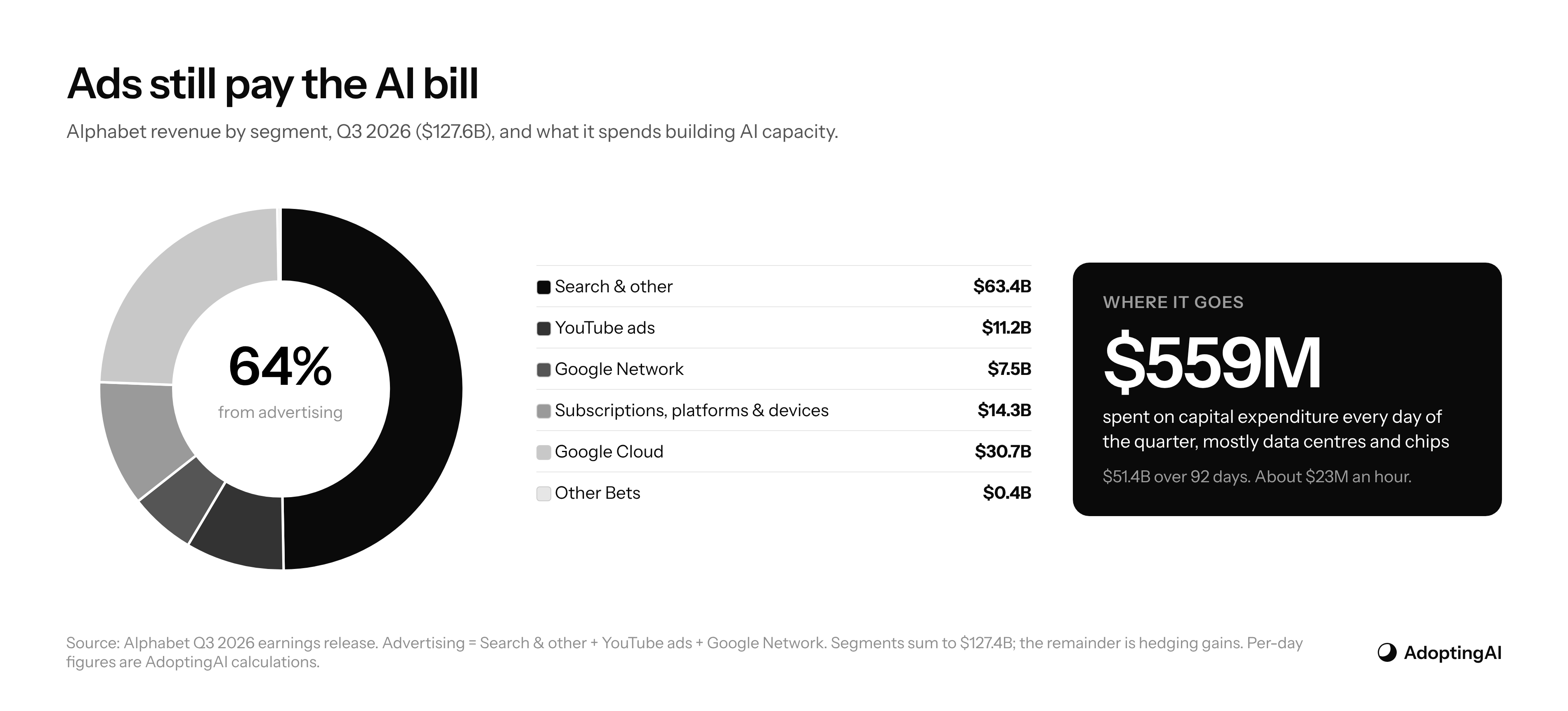
This is the core of the story. Most of Alphabet's revenue, and so most of the cash paying for its AI build-out, still comes from advertising. Google now says AI answers are one of the things slowing search growth. And the build-out costs more cash than the whole company generates.
Put simply: 64% of Alphabet's revenue still comes from advertising. In the quarter it spent about $559 million a day, roughly $23 million an hour, on capital expenditure.
3. Behind the backlog: ventures, guarantees and debt
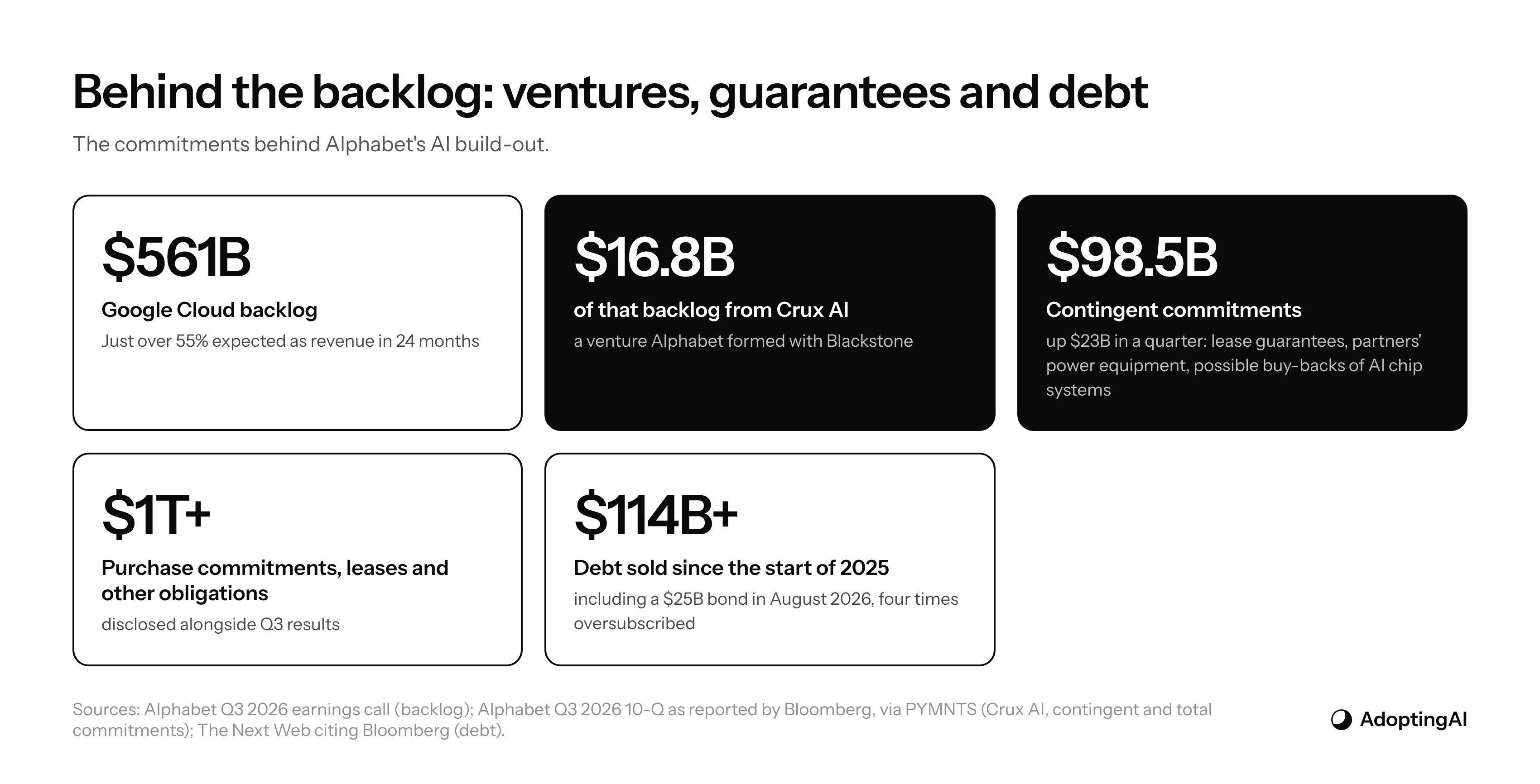
The bull case for all this spending is Google Cloud. Its backlog of signed contracts reached $561 billion, and Alphabet expects just over 55% of it to become revenue within 24 months.
The quarterly filing adds detail that the earnings call did not. As reported by Bloomberg (via PYMNTS):
- $16.8 billion of the backlog comes from Crux AI, a venture Alphabet formed with Blackstone.
- Contingent commitments rose $23 billion in a quarter to about $98.5 billion. They include guaranteeing data centre lease payments, supporting partners' purchases of power equipment, and a possible requirement to buy back AI chip systems from customers.
- Purchase commitments, leases and other obligations now exceed $1 trillion.
Alphabet has also sold more than $114 billion of debt since the start of 2025, including a $25 billion bond in August that drew about $115 billion of orders (The Next Web).
None of this is unusual for an infrastructure build-out, and Alphabet says it expects returns above its cost of capital. But it does change the question investors ask. Dan Morgan of Synovus Trust told Bloomberg the Crux AI backlog raises the question of whether demand is "a self-fulfilling prophecy". The question used to be whether AI demand is real. Now investors also ask who is financing it.
4. Who else pays
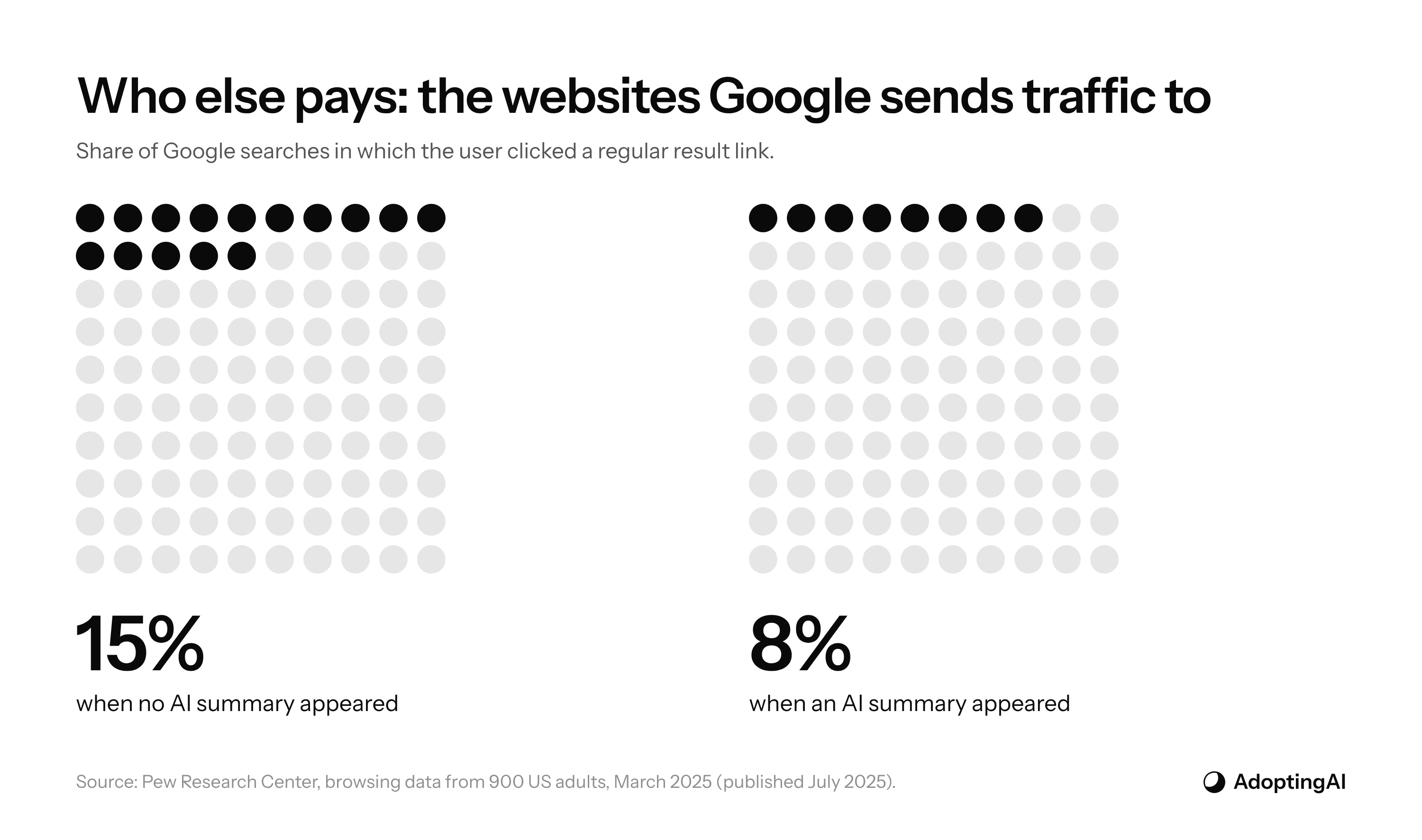
Websites. AI answers also send less traffic to the websites that used to receive the clicks. Pew Research Center tracked the browsing of 900 US adults. People clicked a regular search result in 8% of visits when an AI summary appeared, and in 15% when it did not (Pew Research Center).
India. The same build-out reaches India. In April 2026, Google broke ground on a $15 billion, gigawatt-scale AI hub in Visakhapatnam, which Google calls its "largest commitment to India's digital future" (Khaleej Times). Projects like this are now funded by a company whose capex exceeds its operating cash and whose investors just showed how they react to that. Nothing in the results suggests the Visakhapatnam project will change. But Indian states competing for hyperscale data centres should expect investors to scrutinise every dollar of AI capex more closely than they did a year ago.
What it means
For CXOs buying AI: two of the biggest AI builders, Alphabet and Meta, now spend more cash than they generate. That can last a while, but not indefinitely. Build multi-year AI plans assuming prices and terms may change, and keep the ability to switch vendors. As Issue 04 showed, at least half of US businesses that pay for AI already pay two model vendors.
For marketers and publishers: plan for search to deliver fewer clicks per query and for ads to move inside AI answers. Google is expanding ads in AI Mode, including outside the US. Measure what AI answers say about your brand, not only where you rank.
For policymakers: the companies building national AI infrastructure are now financing it partly with debt and contingent guarantees. Data centre incentives and sovereign AI plans should account for that risk. Publisher traffic is also a policy question: fewer clicks means less revenue for news and independent sites.
For founders and investors: a strong AI product is no longer enough. Alphabet's AI progress was not in doubt on 29 October. What changed was the picture on cash and search growth, and the market repriced it in one day. Investors now ask whether AI growth pays for itself, from the largest companies down to seed stage.
Methodology and sources
All Alphabet financial figures come from its quarterly earnings releases. Management statements come from the Q3 2026 earnings call. Details from the quarterly filing (Crux AI, contingent commitments, total obligations) are as reported by Bloomberg; we have not read the filing directly. Free cash flow is operating cash flow minus purchases of property and equipment, as each company reports it. Microsoft's figures come from its fiscal Q1 2027 earnings release. The $475 billion loss is Bloomberg's close-to-close figure; some outlets report about $482 billion, measured from a different starting point. Comparison market values are from stockanalysis.com and companiesmarketcap.com in late October 2026 and move daily. The defence comparison uses the ₹7.85 lakh crore Union Budget 2026–27 allocation and holds at any exchange rate above ₹83 to the dollar. "Per minute" spreads the loss over a 6.5-hour trading session.
Not tested: how much of the search slowdown comes from AI Mode rather than currency and advertiser categories (Google did not split it out); revenue per query (Google does not publish query volumes); and how Crux AI is financed.
- Alphabet Q3 2026 earnings release, plus Q2 2026 and Q1 2026 releases
- Alphabet Q3 2026 earnings call transcript (Motley Fool)
- Yahoo Finance: Alphabet lost $482 billion in market cap in 1 day
- PYMNTS: Google's AI exposure exceeds the $1 trillion it reported (citing Bloomberg)
- The Next Web: Alphabet borrowed $25bn for AI
- Meta Q3 2026 results
- Microsoft fiscal Q1 2027 earnings release
- Pew Research Center: Google users are less likely to click on links when an AI summary appears
- Khaleej Times: Google breaks ground on $15 billion Indian AI megahub
- CNBC: Alphabet tanks nearly 13% for worst day ever
- XTB: Alphabet disappoints Wall Street despite record results
- Bloomberg and Yahoo Finance, biggest one-day drops in market value for US-listed stocks
- Market values: stockanalysis.com and companiesmarketcap.com; defence budget: Union Budget 2026–27
AdoptingAI is a research newsletter by PanScience. Issue 05.