
Only 4 in 10 numbers AI quotes check out. Here's what that does to adoption.
AI adoption runs on numbers: the statistics that convince a board to invest, and the answers employees act on every day. A new study traced the numbers AI assistants give, and most don't check out. That is not just a media problem. It is why trust, not technology, is now the brake on adopting AI.
44% of salespeople
On 25 October, researchers asked five AI assistants (ChatGPT, Perplexity, Gemini, Claude and Google AI Overviews) how many salespeople give up after one follow-up. All five gave the same number: 44%.
It sounds precise. It has been repeated for years. And researchers who followed it back found it ends at a freelance writer's sample article from around 2017, which cites no research at all (Trakkr Research).
This is a zombie statistic: a number that keeps walking long after anyone can show where it came from. AI did not create it. But AI assistants now repeat it to their users, in a confident voice, with a link that looks like a source.
For anyone adopting AI, this is not a trivia problem. It hits adoption twice.
Why this is an adoption problem
First, numbers about AI decide whether companies adopt it. Boards approve or freeze AI budgets on statistics like "95% of AI pilots fail" or "92% of workers already use AI". As this issue shows, the first is a changed version of what the study said, and the second applies to a narrower group than people assume. One scares companies off. The other pushes them to buy before they know what they need. Either way, the decision starts from a wrong baseline. As Issue 01 showed, only about one in five businesses actually uses AI, so most adoption decisions are still ahead, and still being made on numbers like these.
Second, numbers from AI decide whether people keep using it. Adoption is now running ahead of trust. Two-thirds of employees rely on AI output without checking it, and more than half say AI has caused mistakes in their work. Among developers, the heaviest users of AI, distrust of its accuracy rose from 31% to 46% in a year.
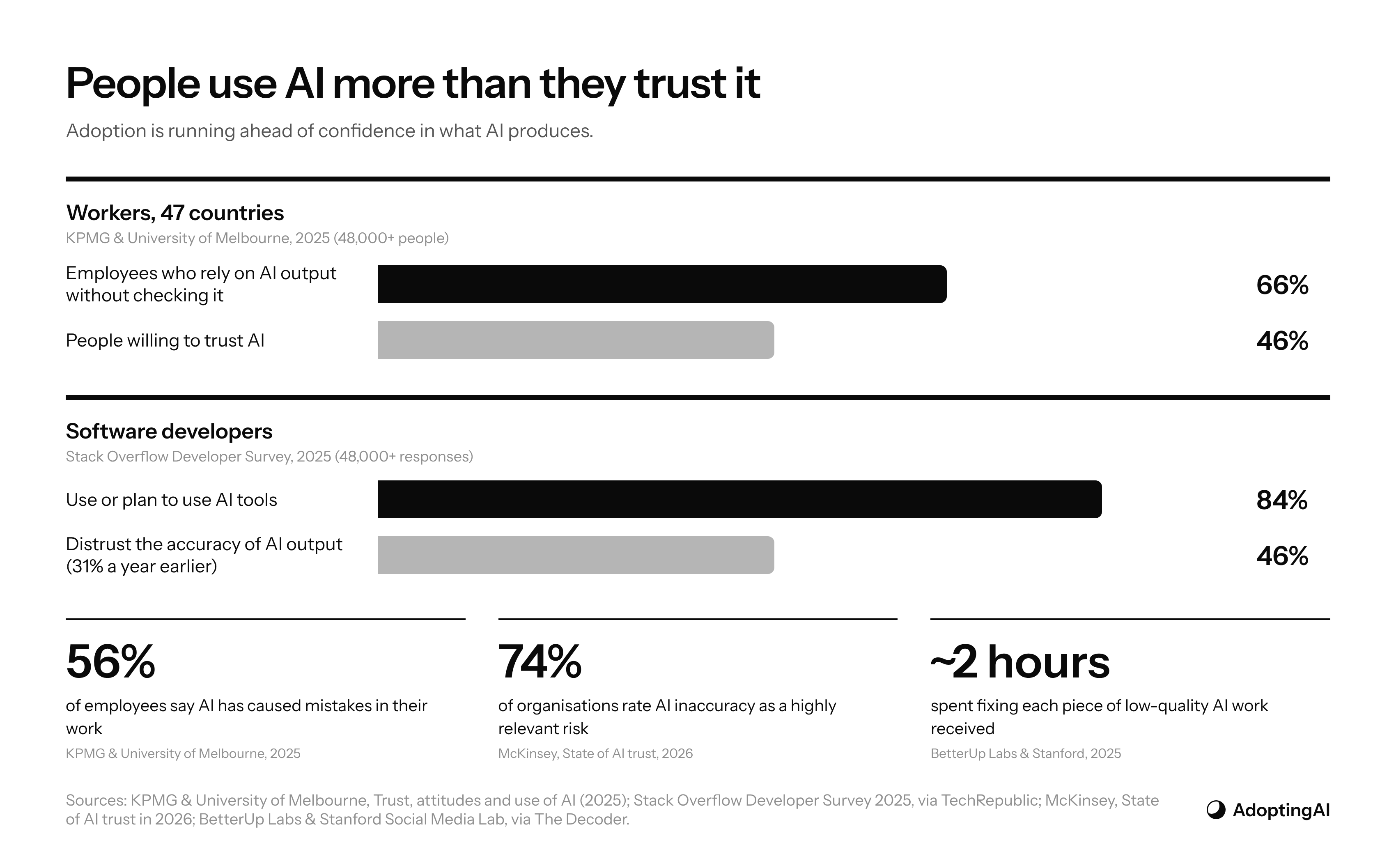
That creates two ways for adoption to fail. If people trust AI too much, errors reach customers, courts and boards, and the backlash can end in bans. If they trust it too little, every output has to be checked, and the checking eats the productivity gain that justified the purchase. One study of US workers put the cost of fixing low-quality AI work at nearly two hours per incident and about $186 per employee per month (BetterUp Labs and Stanford, via The Decoder).
Zombie statistics are the clearest, most measurable case of that gap. So it is worth looking at exactly how often AI's numbers hold up.
What the research found
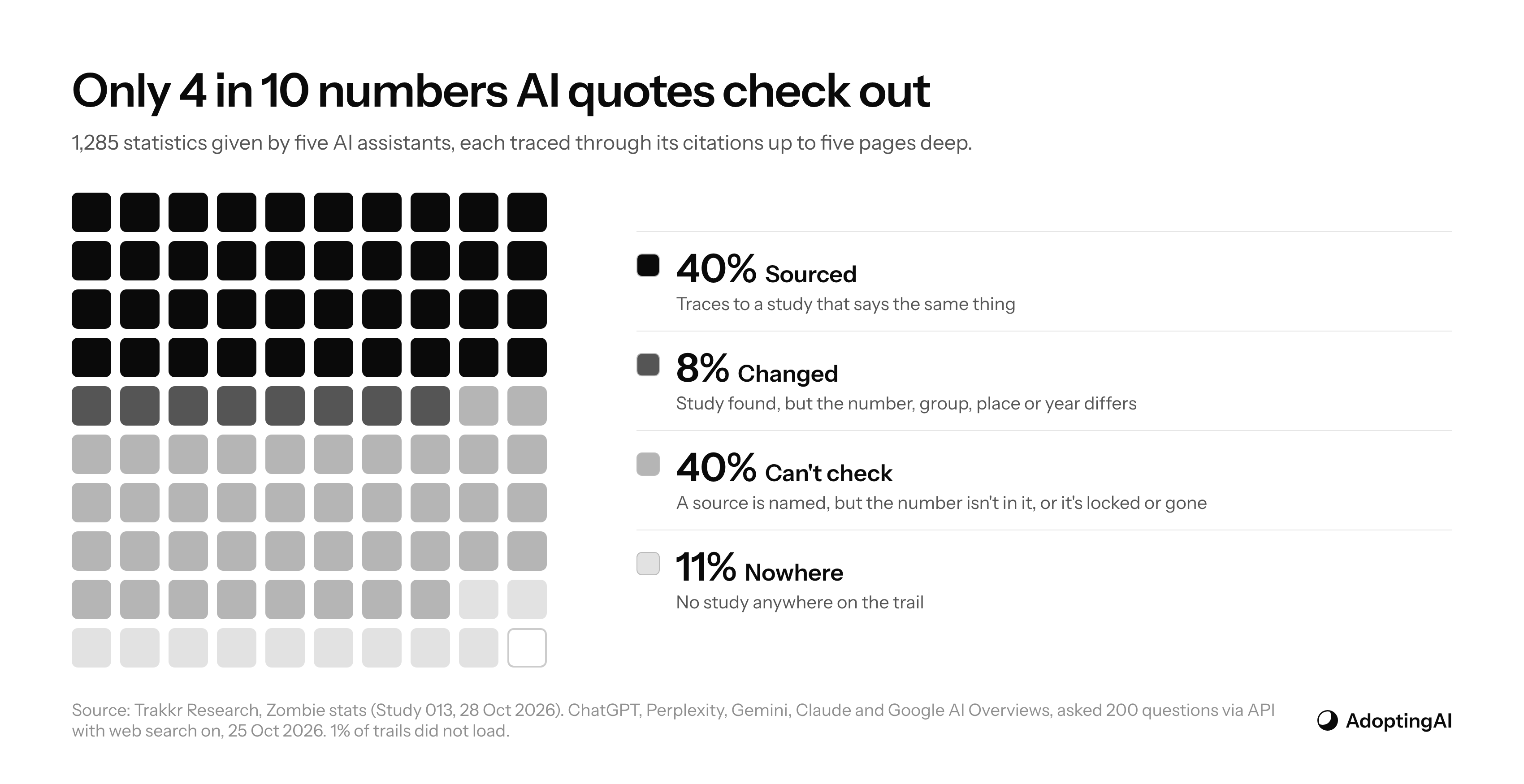
Trakkr, a company that tracks how AI assistants cite brands, published the study on 28 October. Its researchers asked the five assistants 200 questions that call for a number, through each company's API with web search switched on. They then took 1,285 of the statistics in the answers and followed each one through its citations, up to five pages deep, to see whether it reached an original study.
- 40% traced to a study that says the same thing.
- 8% reached a study, but the number had changed on the way: a different figure, group, place or year.
- 40% could not be checked: a real source was named, but the number wasn't in it, or the source was locked or gone.
- 11% led nowhere: no study anywhere on the trail.
One nuance matters. Trakkr found the assistants generally did not invent numbers. The figure appeared on the page they cited 82% of the time. The problem is what those pages are. Only 21% of them were original research. The machines aren't making the numbers up. They are passing on numbers that someone else made up, misread or lost track of.
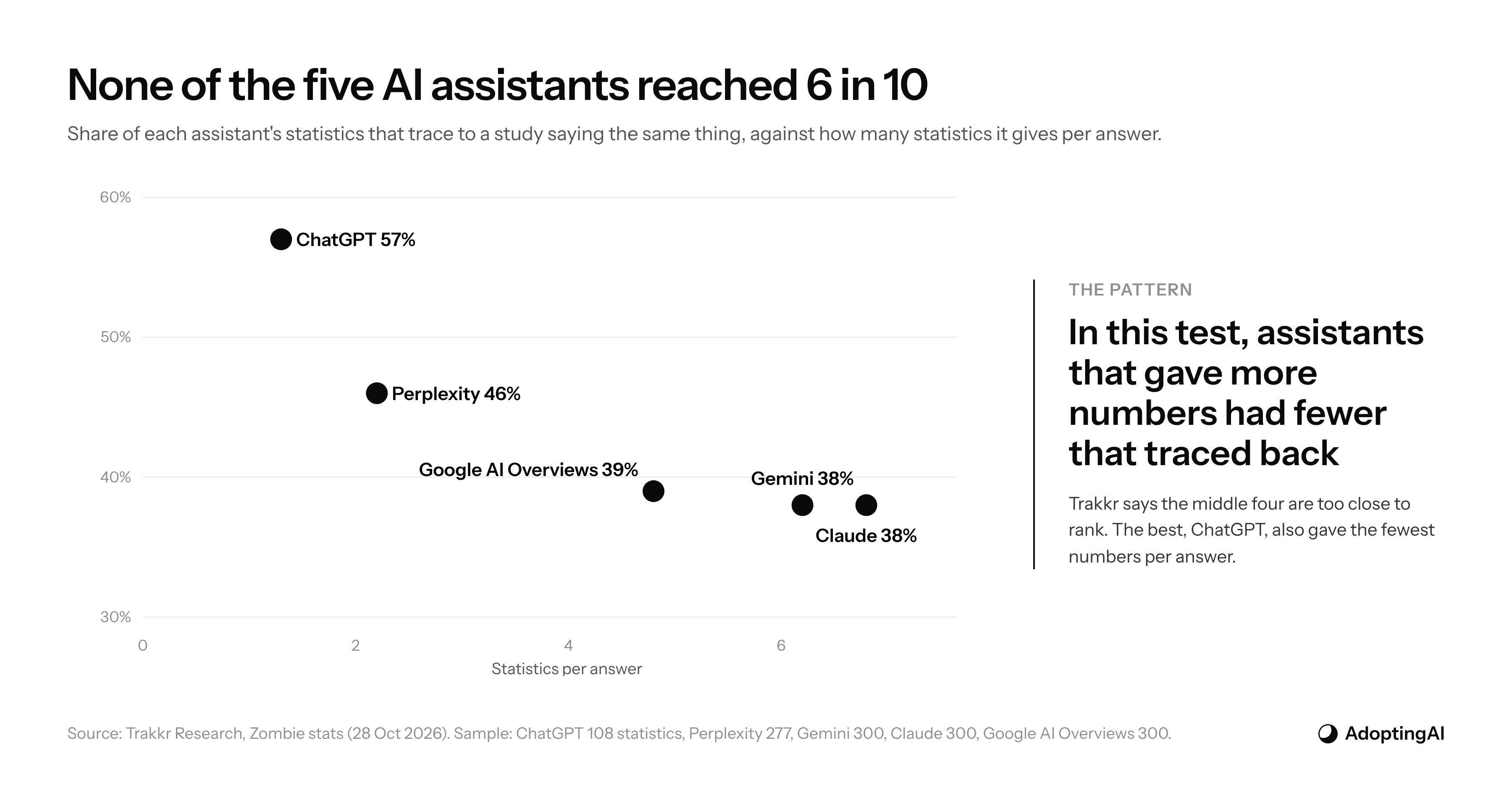
No assistant did well. ChatGPT's statistics traced back most often, at 57%. Gemini and Claude were lowest, at 38% each. Trakkr says the middle four are too close to rank. The assistants that gave the most numbers per answer also had the fewest that checked out.
How a zombie number is born
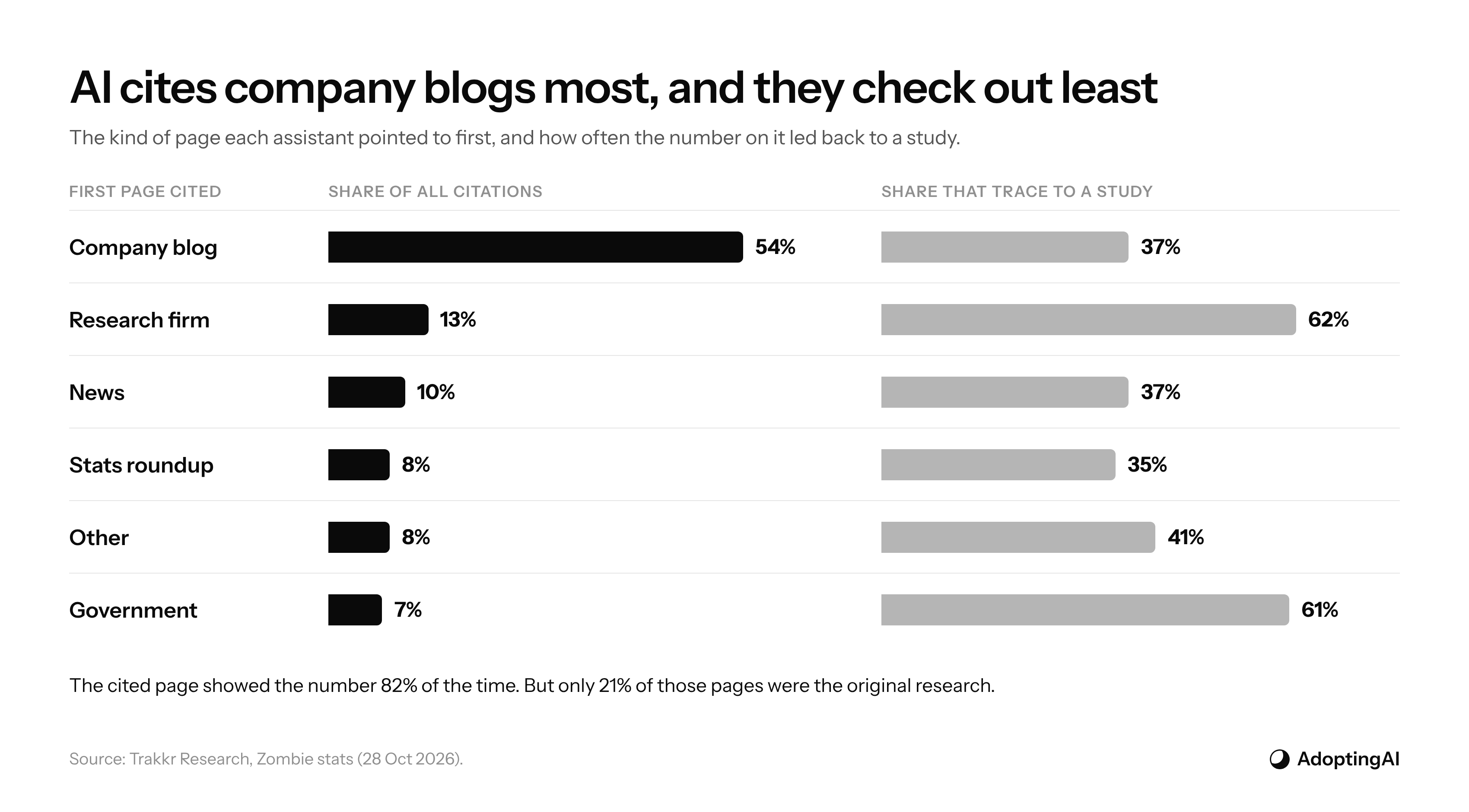
Most of the pages AI assistants cite are not research. Company blogs made up 54% of the first pages cited, and only 37% of their numbers led back to a study. Government pages and research firms did far better, at 61% and 62%, but together they were only a fifth of what got cited.
One common path goes like this. A study finds something narrow. A blog rounds it up. A roundup of statistics copies the blog, without a link. Years later, the number is quoted as a general fact, and the study it came from says something else. Trakkr's examples show how it happens:
- "95% of generative AI pilots fail." MIT NANDA's 2025 report said 95% of organisations saw no measurable return, which is a different claim.
- "Only 4% to 10% of unhappy customers complain." It traces to research from 1979, whose author says it applied to small purchases.
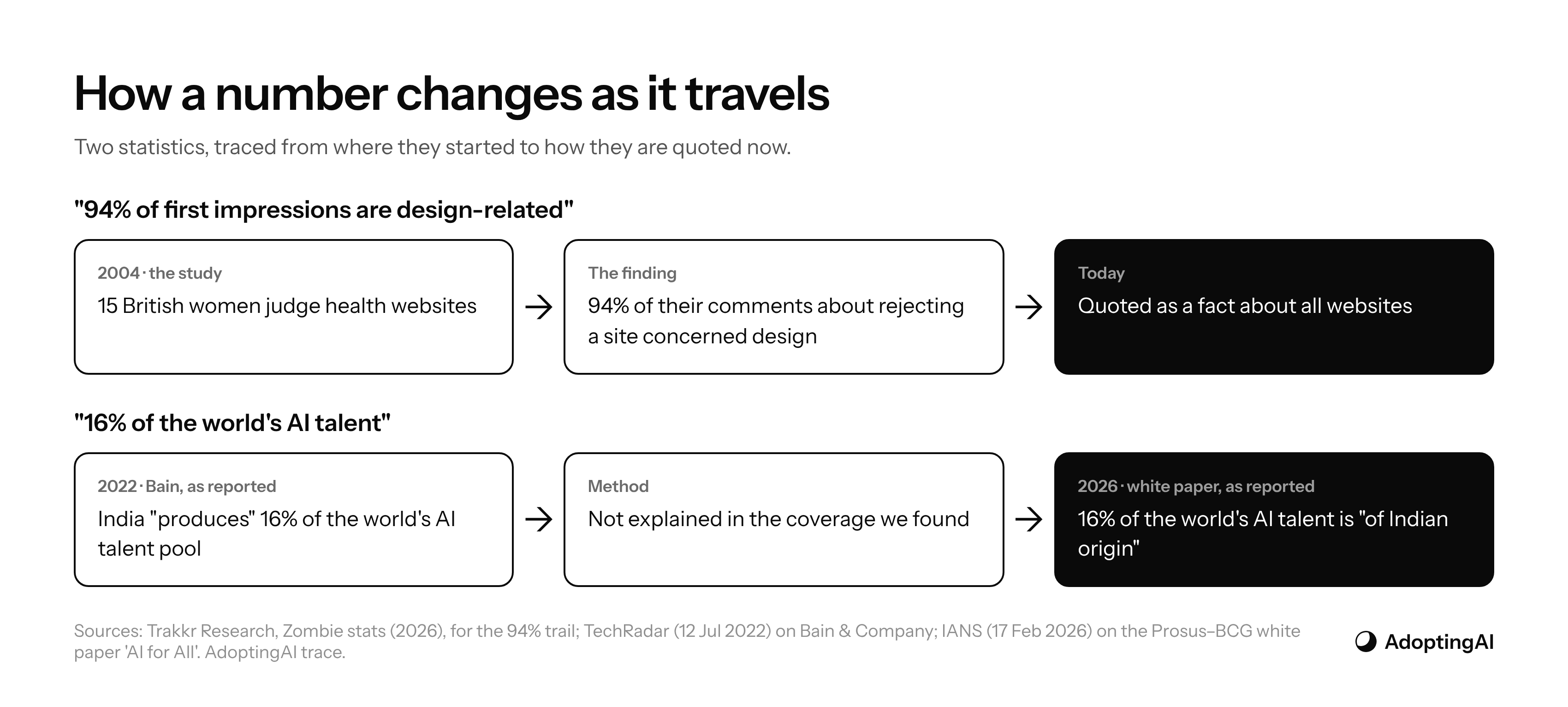
- "94% of first impressions are design-related." It began as a 2004 study of 15 British women judging health websites. 94% of their comments about rejecting a site were about design. It is now quoted as a fact about all websites.
The same thing happens closer to home. In 2022, coverage of a Bain report said India "produces" 16% of the world's AI talent. In 2026, a white paper launched at the India AI Impact Summit was reported as saying 16% of the world's AI talent is "of Indian origin". Same number, different claim, and neither piece of coverage we found explained how it was calculated.
We traced four numbers India repeats about AI
To see how this plays out in India, we took four statistics that often appear in coverage of AI in India, and followed each one back to the earliest source we could find.
- "92% of Indian knowledge workers use AI at work." This one is real: Microsoft and LinkedIn's Work Trend Index, May 2024, a survey of 31,000 people in 31 countries (Microsoft). But it covers knowledge workers only, not all workers. It is a vendor's survey, now two years old, and the release does not give the size of the India sample.
- "16% of the world's AI talent is Indian." Changed. As described above, "produces" in 2022 became "of Indian origin" in 2026 (TechRadar, IANS).
- "AI could add $957 billion to India's economy." Sourced, but dated. It comes from Accenture's 2017 report Rewire for Growth. It is a scenario for 2035 that assumes the "right investments" are made (Business Standard).
- "AI will add $450–500 billion to India's GDP by 2025." Expired. It is a 2020 NASSCOM estimate of potential, for a year that has now passed (Business Standard). We found no follow-up measuring whether it happened.
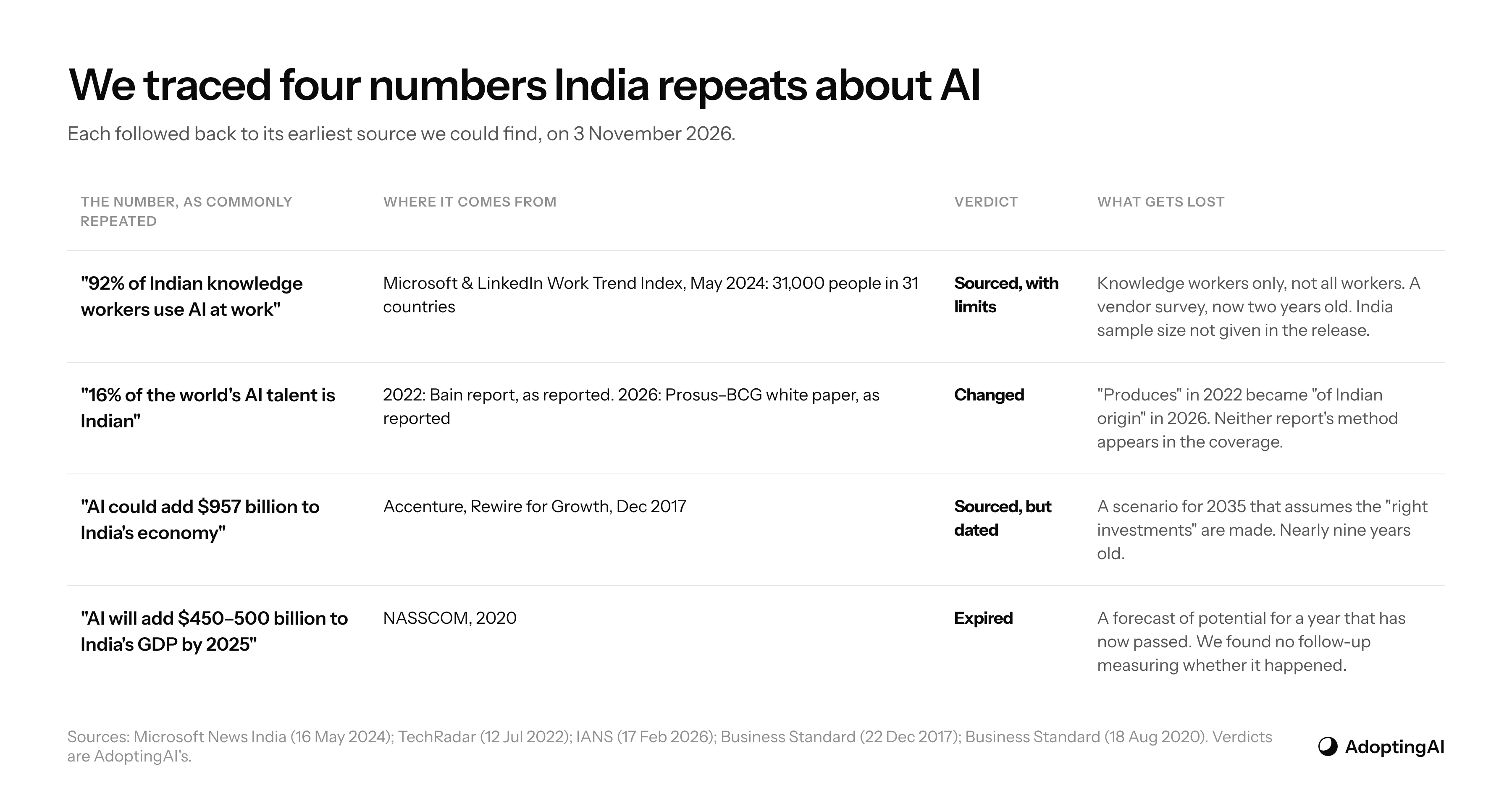
None of these is invented. But each comes with conditions that tend to disappear once the number starts travelling on its own. And these are the numbers that set expectations for how fast AI will pay off in India. When an expectation rests on a scenario or an expired forecast, the disappointment that follows tends to get blamed on AI itself.
Why it spreads faster now
Zombie numbers are not new. What is new is how they reach people.
Fewer people click through. When an AI summary appears in Google, people click a regular result in 8% of visits, against 15% without one (Pew Research Center). The link is there, but fewer people follow it, so fewer people would ever notice that it leads nowhere.
Agreement looks like proof, but isn't. Of the 29 statistics that at least three assistants repeated, only 11 traced back to a study. All five assistants gave the same 44% for salespeople, and it still led nowhere. When the tools agree, it can simply mean they read the same pages.
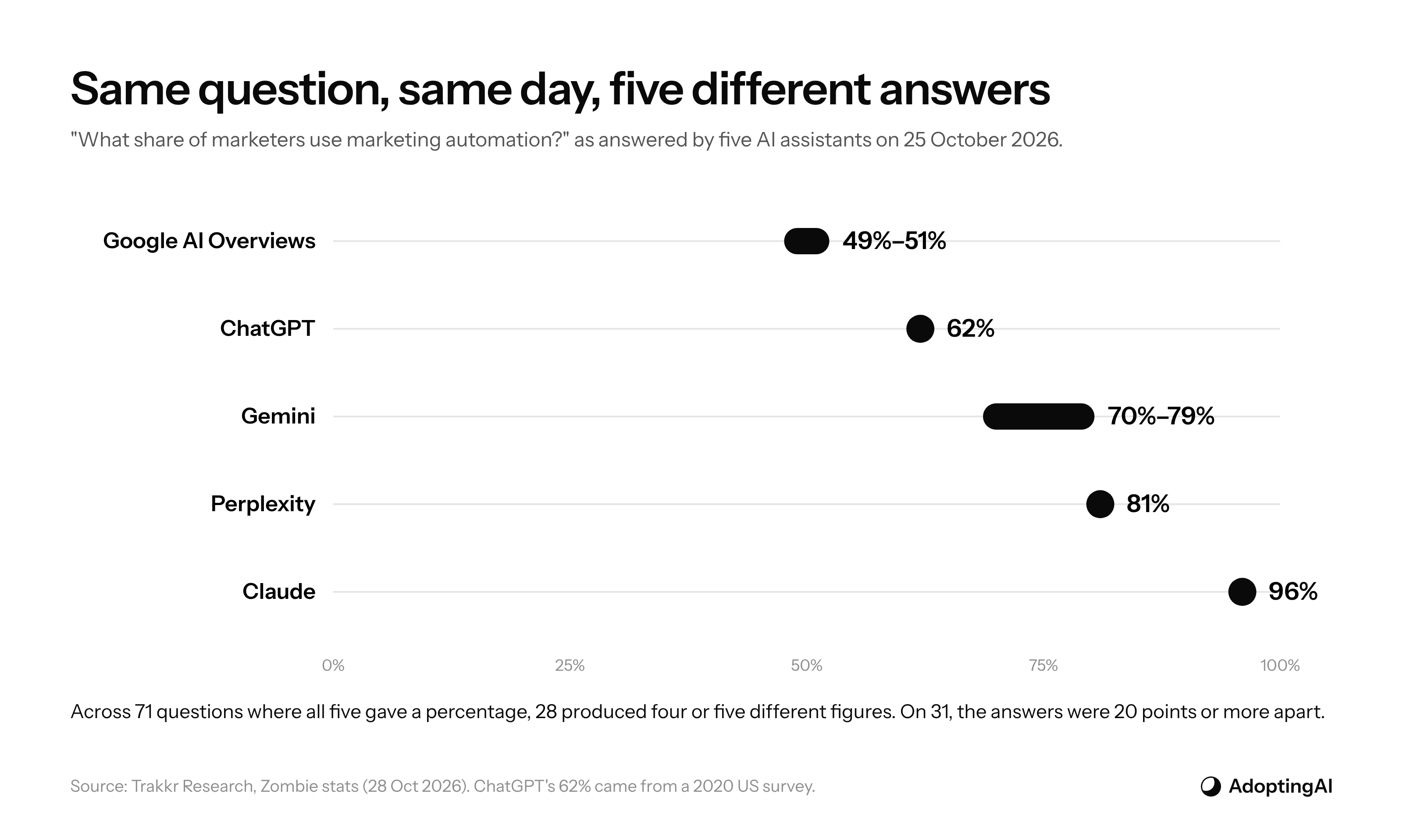
And when they disagree, you get to pick. Asked what share of marketers use marketing automation, the five assistants answered anywhere from 49% to 96% on the same day. Across 71 questions where all five gave a percentage, the answers were 20 points or more apart on 31 of them. A deck can cite whichever number suits it, and "according to AI" sounds like a source.
Who pays when the number is wrong
Zombie numbers are the quieter cousin of a louder problem: AI tools that produce sources that never existed. Both end up in the same places, and both have already cost people.
Consultants. In 2025, Deloitte agreed to refund part of an AU$440,000 contract with Australia's Department of Employment and Workplace Relations. A report it delivered contained references to reports that did not exist and a made-up quote from a court judgment. Its methodology disclosed use of a generative AI tool, though Deloitte's internal review reportedly blamed human error (The Register).
Courts. In February 2026, India's Supreme Court flagged petitions that cited judgments and quotations that were inaccurate or did not exist, apparently drafted with AI and not checked. Chief Justice Surya Kant said every citation must be verified against authentic sources before it goes on record (Business Standard).
Boards and policymakers. A forecast of AI's contribution to GDP, a share of workers using AI, a failure rate for AI pilots: these are the numbers that justify budgets, schemes and strategies. When they are stale, narrowed or untraceable, the decision built on them inherits the error. And because the number came "from AI", it can feel more neutral than a vendor's slide, when it may be exactly that vendor's slide.
How to adopt AI without adopting its bad numbers
The answer is not to adopt less. It is to adopt in a way that makes checking cheap, and to count the cost of checking honestly. Start with a five-question test for any number before it goes into a deck, a policy note or a post:
- Who measured it? Open the cited page. Is it the study, or a page quoting someone else? If it is a blog or a roundup, keep following the links.
- When? A 2017 forecast and a 2026 survey are not the same kind of evidence. Forecasts for years that have already passed should be retired.
- Of whom? Check the group. "Knowledge workers" is not "workers". "15 women judging health websites" is not "all website visitors".
- Does the number match the claim? "95% saw no measurable return" is not "95% of pilots fail". Read the sentence the number sits in.
- Would you cite it without the AI? If the only source you can name is "ChatGPT said" or "Google's AI said", you don't have a source yet.
For CXOs: build verification into AI workflows rather than leaving it to individuals, and include its cost when you measure AI's return. Start with uses where errors are cheap or easy to check, such as drafting and summarising your own documents, before uses where the AI supplies facts. When you choose AI research tools, prefer ones that link to primary sources. And make tracing a rule for any number that reaches the board, including the numbers used to justify your AI strategy.
For marketers: if you publish statistics, link to the original study. In Trakkr's study, company blogs were the pages AI assistants cited most, and among the least likely to lead back to a study.
For policymakers: when a number justifies public money, ask for the original study and its date, not the summary.
Methodology and sources
The global findings come from Trakkr Research's Zombie stats (Study 013, 28 October 2026). Trakkr asked ChatGPT, Perplexity, Gemini, Claude and Google AI Overviews 200 questions through their APIs, with web search on and a US location, on a single day (25 October 2026), and traced 1,285 statistics. An AI model judged each trail, a second model re-checked 300, and researchers hand-checked a sample. Trakkr notes that consumer apps may answer differently, that answers change daily, and that paywalled sources were counted as "can't check", not as missing. Trakkr sells AI search monitoring, so it has a commercial interest in this topic; its data file is published alongside the study.
The four India statistics were traced by AdoptingAI on 3 November 2026 through public news coverage and company releases. Where we could not open the original report, we say "as reported". The verdicts are ours.
A note on our own tools: AdoptingAI uses AI assistants in research, including one of the assistants in this study. Every number in this issue links to the page it came from.
Not tested: how these results compare in Indian languages or with an Indian location; how the consumer apps differ from the APIs; and whether the original Bain and Prosus–BCG reports explain the 16% figure.
- Trakkr Research: Zombie stats
- Pew Research Center: Google users are less likely to click on links when an AI summary appears
- Microsoft News India: 92% of Indian knowledge workers use AI
- TechRadar: India provides 16% of the world AI talent pool (2022)
- IANS: 16 pc of world's AI talent is of Indian origin (2026)
- Business Standard: AI could help add $957 bn to Indian economy (2017)
- Business Standard: Data, AI have potential to add $500 billion to economy by 2025 (2020)
- The Register: Deloitte refunds Australian government
- Business Standard: Supreme Court flags unverified use of AI in court filings
- KPMG & University of Melbourne: Trust, attitudes and use of AI (2025)
- TechRepublic: Stack Overflow 2025 survey on developer trust in AI
- McKinsey: State of AI trust in 2026
- The Decoder: AI-generated workslop study (BetterUp Labs & Stanford)
AdoptingAI is a research newsletter by PanScience. Issue 06.