
Enterprise AI spending grew more than fivefold this year. But look at where it went, and AI adoption turns out to be far narrower than the headlines suggest. The reason is not the technology. It is how organisations are built.
$177 billion, two use cases
In 2026, US enterprises will spend about $177 billion putting AI to work, up from $33 billion last year (Menlo Ventures). By that measure, AI adoption looks like it has arrived.
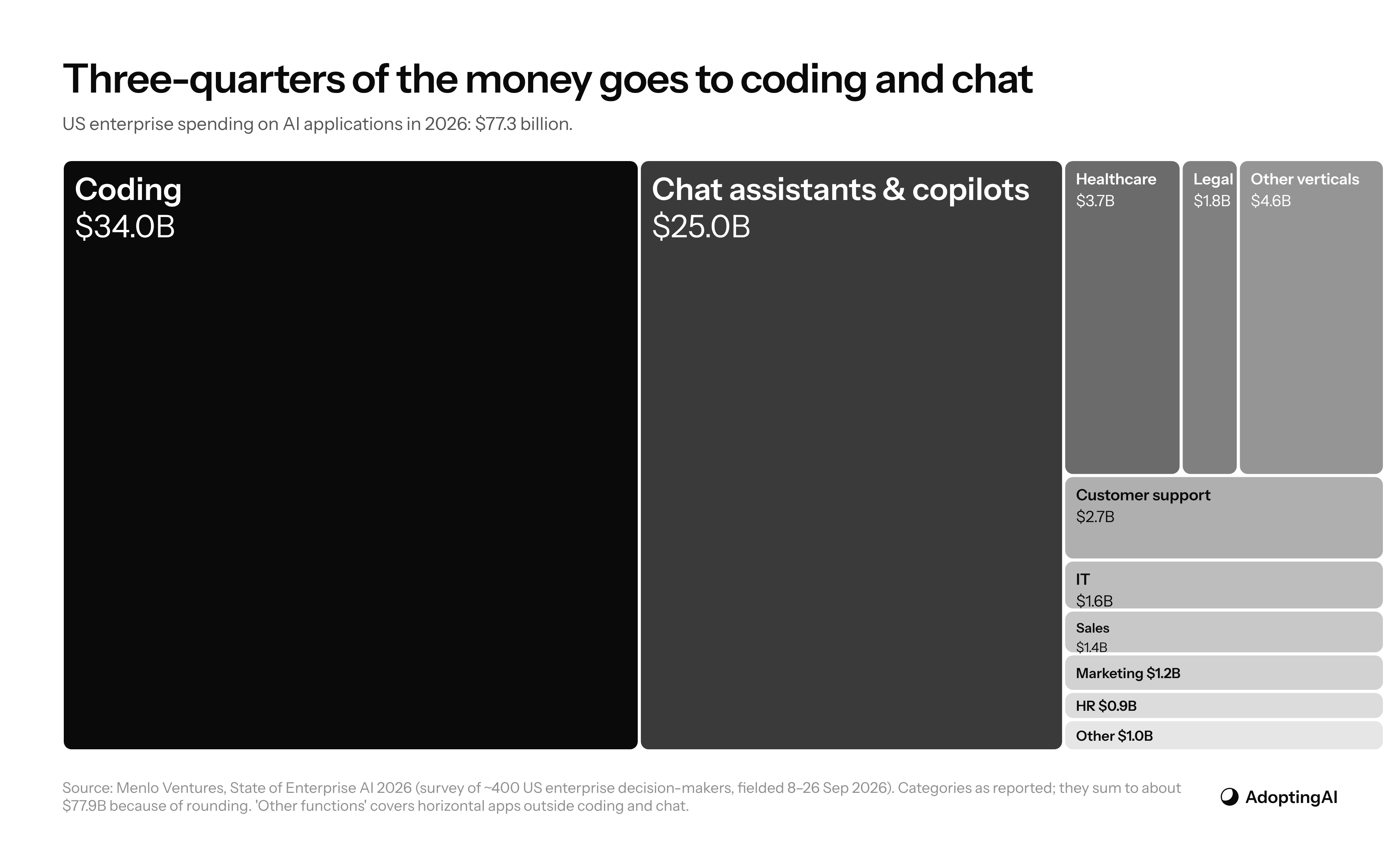
But of the $77 billion spent on AI applications, about three-quarters went to just two things: tools that help people write code, and chat assistants. Everything else a company does, from customer support and sales to HR, marketing, finance and every specialist industry tool, shares what is left.
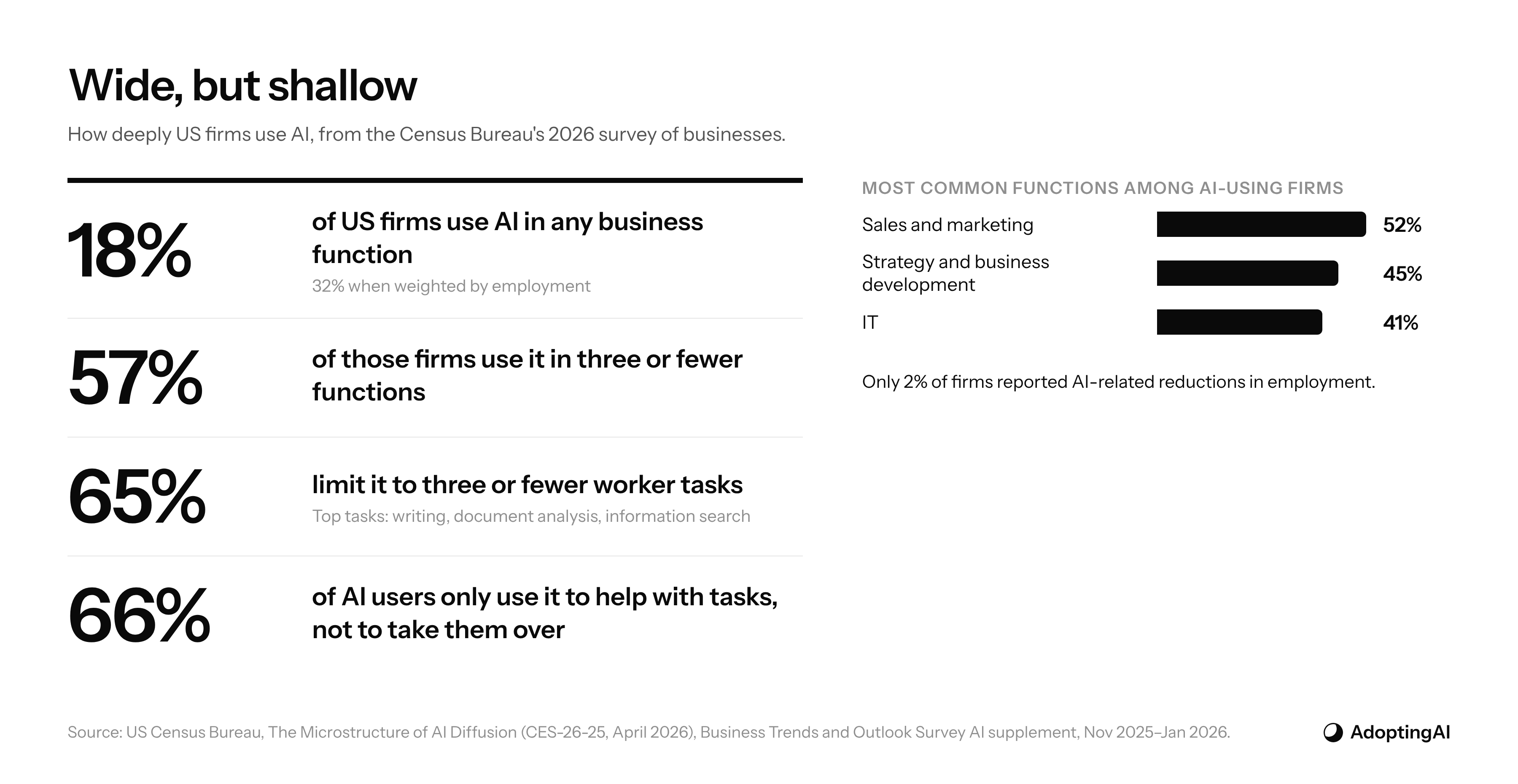
The US government's own survey of businesses tells the same story. The US Census Bureau found that only 18% of US firms use AI in any business function. Of those, most use it in three or fewer functions, and the most common tasks are writing, analysing documents and searching for information. That is, mostly, chatbot work (US Census Bureau).
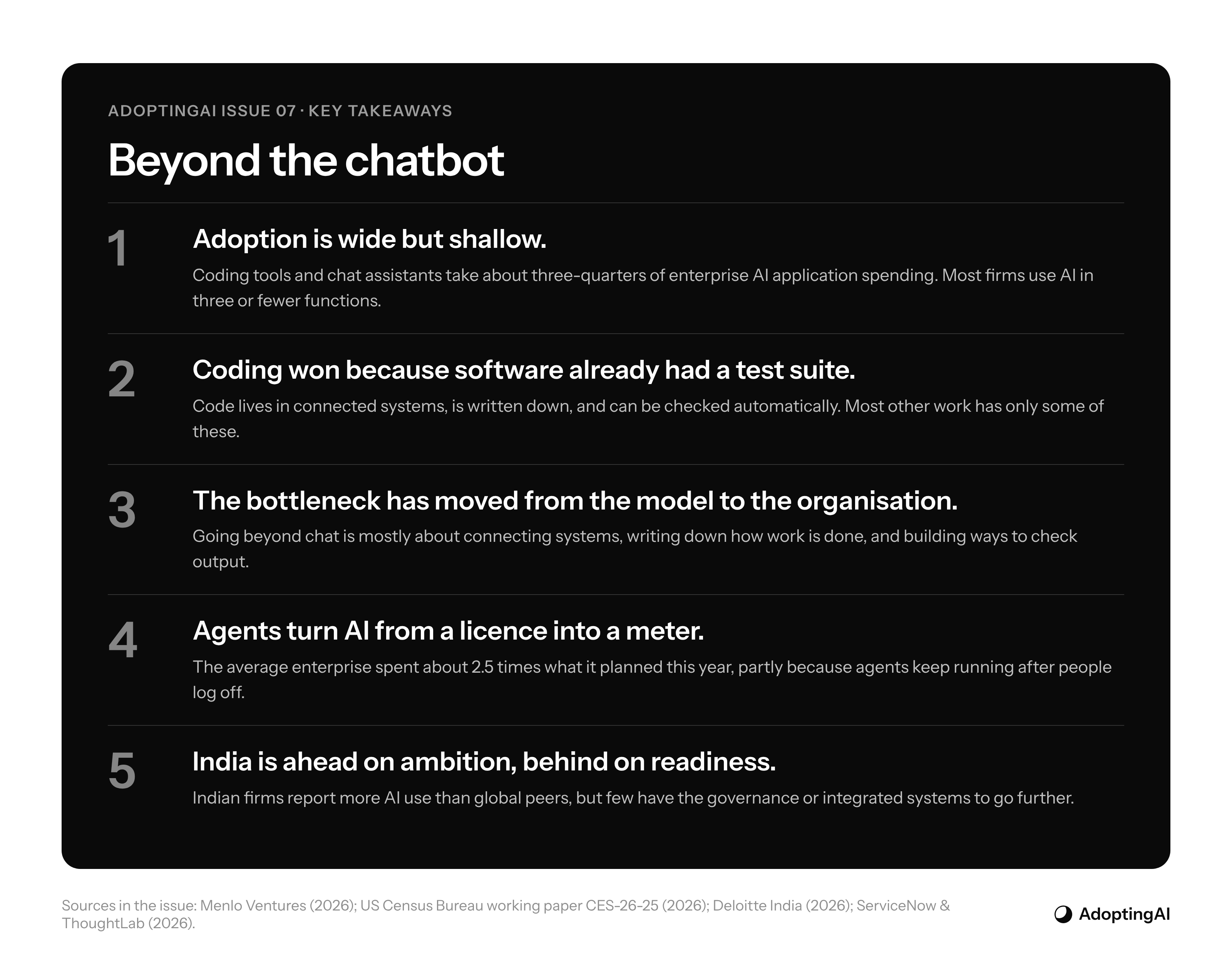
So the real question for 2027 is not whether companies adopt AI. It is why AI has gone so deep in a few places and barely anywhere else, and what it takes to move beyond the chatbot.
1. Wide, but shallow
Menlo Ventures surveyed nearly 400 US enterprise decision-makers in September. Its numbers show how lopsided AI spending has become:
- Coding tools: $34.0 billion, up 7.7x in a year.
- Chat assistants and copilots: $25.0 billion, up 3x.
- Specialist industry AI: $10.1 billion, led by healthcare ($3.7 billion) and legal ($1.8 billion).
- Every other business function combined: $8.8 billion. Customer support is the largest at $2.7 billion. IT, sales, marketing and HR are each under $2 billion.
Money concentrates; use spreads thinly. The Census Bureau's 2026 survey covered AI use from November 2025 to January 2026. It found that 18% of US firms use AI in a business function (32% when weighted by employment). Among those firms, 57% use AI in three or fewer functions, and 65% use it for three or fewer worker tasks. Two-thirds of AI users only use it to help with tasks, not to take them over. Just 2% of firms reported AI-related job reductions.
Put together, the picture is clear. AI has been adopted widely as a writing and coding assistant. As a way of running a business function end to end, it has barely started.
2. Our view: every function needs its own compiler
It is tempting to explain coding's lead by saying developers adopt new tools early. We think that misses the point.
Menlo's report names three conditions where AI agents work: an environment they can act in (connected systems), complete context to learn from (documentation and worked examples), and results they can verify. Coding has all three. Code lives in connected repositories. How it should work is written down in documentation, tickets and the code itself. And whether it works can be checked automatically, by a compiler and a test suite, in seconds.
Here is the part we want to stress. None of those three conditions is about how smart the AI model is. All three are about the organisation around it. Software teams spent decades building version control, documentation habits and automated testing for their own reasons, long before AI. AI simply inherited that infrastructure.
Most other functions never built it. A marketing team's best practice lives in a few people's heads. Whether an HR decision was right may not be clear for a year. A sales forecast is checked by the quarter, not by a test that runs in seconds. When output can't be checked cheaply, every AI answer needs a human to review it. That is exactly the trust gap we described in Issue 06, and it caps how far AI can go.
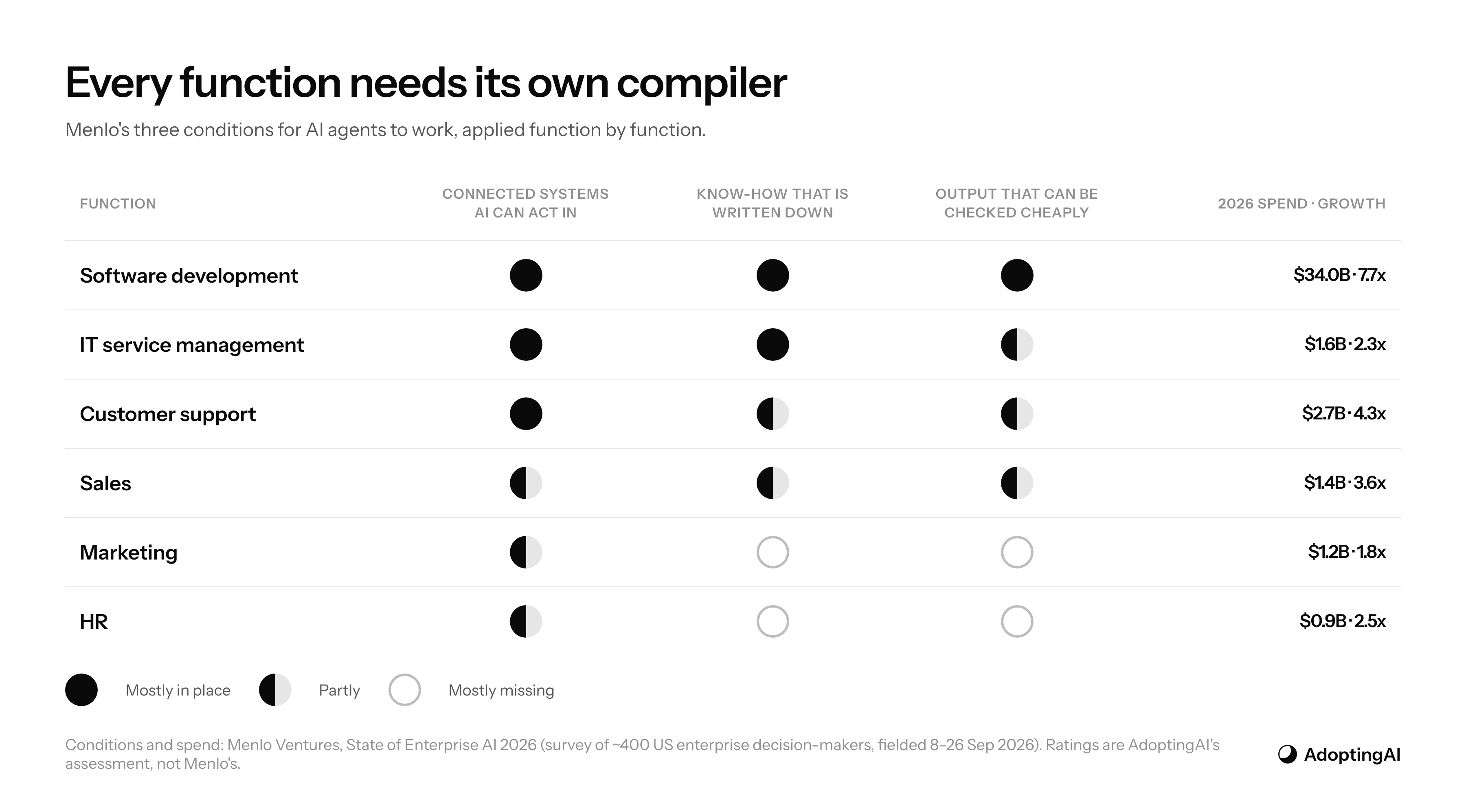
This leads to a conclusion that cuts against much of the current excitement. A better model will not, on its own, take AI beyond the chatbot. What will is the dull work: connecting systems, writing down how work is actually done, and building ways to check results, such as reference answers, scoring rubrics and audit samples. In effect, each function needs its own version of a compiler. The functions that build one first will be the next to see AI spending take off.
The Census Bureau's data points the same way. Firms that integrate AI more broadly, across more functions and with investment in their operations, show stronger commercial performance.
3. Agents turn AI from a licence into a meter
Where AI does go beyond chat, it changes what companies are paying for. A chat assistant is a licence: a fixed fee per person. An agent is closer to a meter: it runs tasks on its own, often several at once, and the bill depends on how much work it does.
The effect is already showing up in budgets. The average enterprise in Menlo's survey had planned to spend 1.9 times what it spent on AI in 2025. It actually spent 4.7 times as much, roughly 2.5 times its plan. For the median enterprise, the overshoot was smaller: 2.2x actual against 1.8x planned. Menlo attributes much of the gap to agents that "keep going even after people step away".
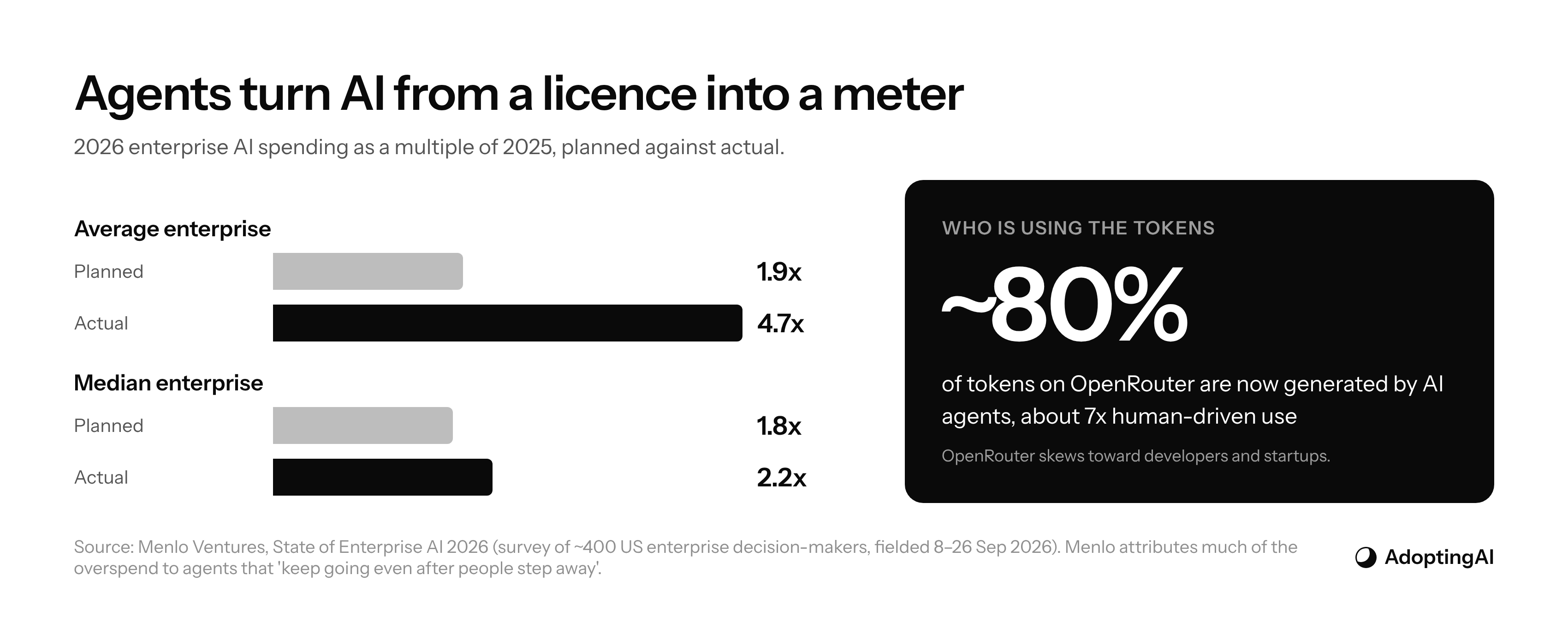
Another signal: on OpenRouter, a service developers use to access many AI models, agents now generate about 80% of tokens, roughly seven times as much as people typing directly. OpenRouter skews toward developers and start-ups, so this is an early indicator rather than a picture of all enterprises.
This matters for adoption because it makes AI spending behave less like software licences and more like cloud computing, where costs rise with use. CFOs who budgeted for seats are now managing consumption. That is a reason to measure what agents produce, not just what they cost, before scaling them.
4. The AI nobody chose
There is a second way AI goes beyond the chatbot, and it does not involve a new project at all. It arrives inside software companies already use.
Across AI applications as a whole, new AI-native companies are winning: they take 77% of AI application spending overall and 96% in coding. But in IT, ServiceNow holds 91% of AI spending. In HR, Workday holds 68%. In data science, Databricks and Snowflake together hold 88%. Menlo found that established vendors gained share in nearly half of the categories it tracks this year.
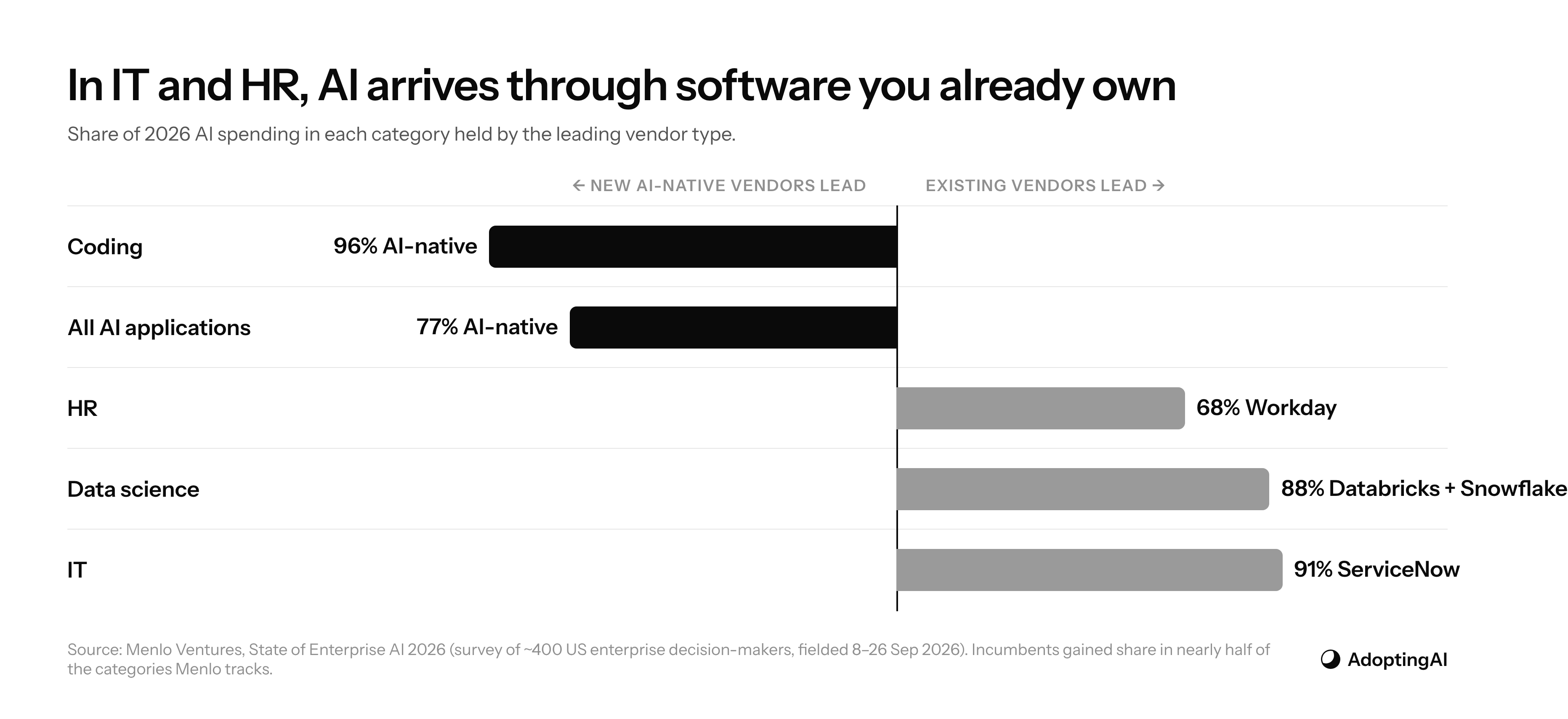
This is adoption by upgrade. AI features appear in the ticketing system, the HR platform or the data warehouse through a contract renewal, often without a separate decision to adopt AI. It is also the route by which AI reaches functions that score poorly on the three conditions above: the incumbent already holds the connected system and much of the data.
The risk is that nobody owns it. If AI arrives through a vendor update rather than a business case, it can end up with no one measuring whether it works and no one checking its output. As we argued in Issue 06, unchecked AI output is where trust breaks down. Every company should know which of its existing vendors have switched on AI, and who is accountable for it.
5. India: ahead on ambition, behind on readiness
Indian enterprises report using AI more heavily than their global peers. In Deloitte's 2026 survey, 40% of Indian respondents reported significant or full AI use, against about 28% globally. Use at scale was most common in product development (62%) and strategy and operations (56%) (Deloitte India).
The foundations needed to go beyond chat are much thinner. ServiceNow's survey of 350 Indian senior leaders, published in September, found (ServiceNow):
- Enterprise AI investment grew 119% in a year, above the 110% global average.
- 54% are deploying AI agents, but only 11% have moved to autonomous workflows.
- Only 22% have processes to test, audit and assess the risks of AI.
- Only 18% have replaced fragmented legacy systems with an integrated platform, and 74% say data accuracy, access and management need work.
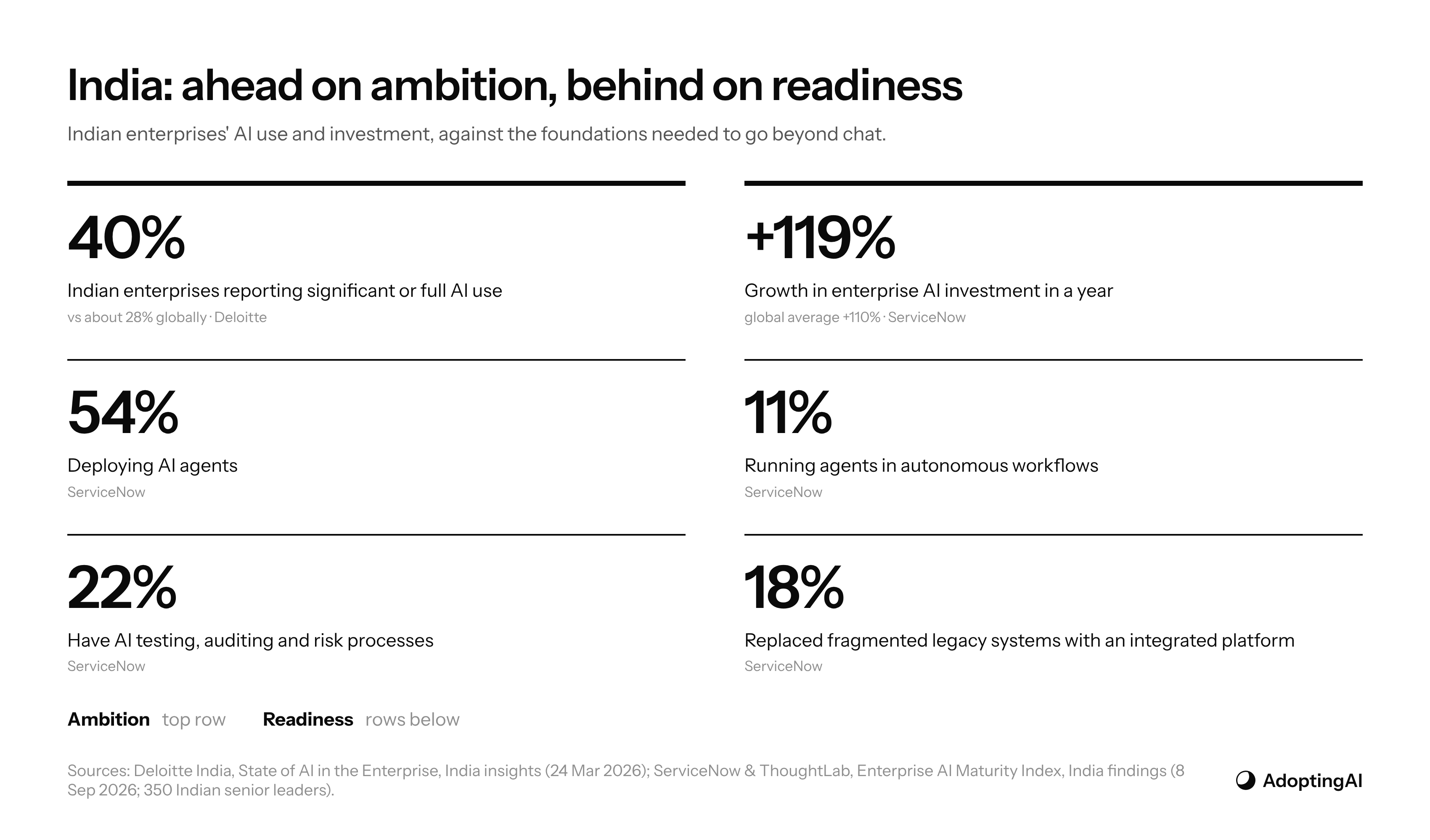
Read against the three conditions, this is the gap that matters. Indian companies are investing in AI fast, but connected systems, written-down processes and ways to check output are what let AI move from assistant to operator. Those are still rare.
There is a second Indian story here, and it is less comfortable. The work AI handles best, such as writing and testing code, IT operations and routine support, is a large part of what India's technology industry sells to the world. Infosys shows the tension. Its AI work is growing fast: 10.5% of revenue, up 29% in a single quarter. But total revenue grew only 1.5% year on year, and it cut its growth forecast for the year to 1–2% (Infosys Q2 FY27 results). Across the industry, NASSCOM estimates AI revenue at $10–12 billion out of $315 billion for FY26 (Business Standard).
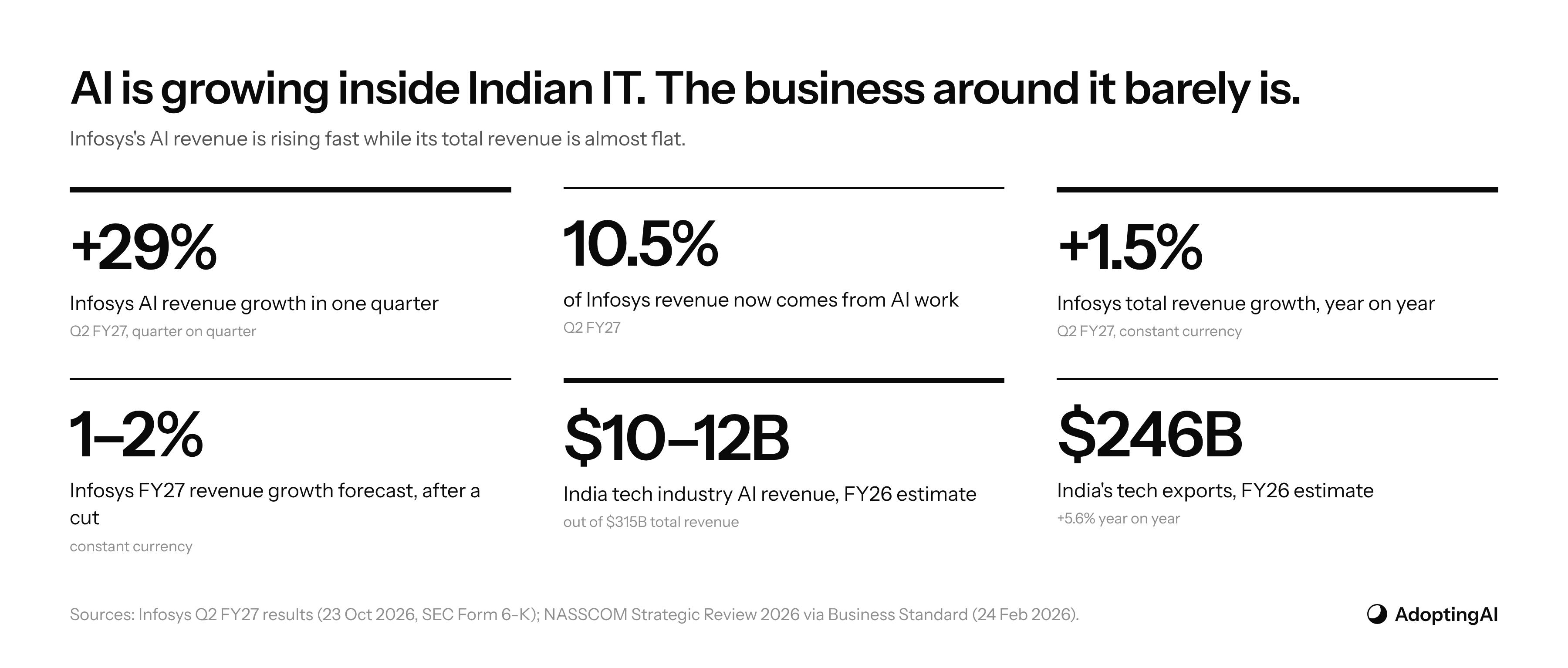
We can't prove from these numbers alone that AI is shrinking existing contracts. But the pattern is worth watching: if AI goes deepest where work is easiest to check, India's export industry sits right where AI adoption is moving fastest.
What it means
For CXOs: stop measuring AI adoption by how many people have a chatbot licence. Pick one function and ask the three questions: Can AI act in its systems? Is the know-how written down? Can output be checked cheaply? Fix whichever is missing before buying more AI for it. Budget for agents the way you budget for cloud, with usage limits and a measure of output, not just seats. And list which of your existing vendors have switched on AI features, with a named owner for each.
For founders: the open opportunity is not another assistant. It is building the missing "compiler" for a function: the connectors, the captured know-how and the checking layer that let AI do real work in marketing, HR, finance or a regulated industry. Specialist AI is already worth $10.1 billion, led by healthcare and legal, where checking output is non-negotiable.
For policymakers: adoption programmes that fund AI tools alone will mostly fund chatbots. The bigger lever is the foundations: digitising and connecting records, standard data formats, and public test sets that let companies check AI in their sector. For India, the IT services industry needs a plan for a world where the work AI handles best is also the work it exports most.
The one-line takeaway: AI goes where its work can be checked. If you want AI to go further in your organisation, make your work checkable first.
Methodology and sources
Spending figures come from Menlo Ventures' State of Enterprise AI 2026, a survey of nearly 400 US enterprise decision-makers responsible for more than $4 billion in AI spending, fielded by Morning Consult from 8 to 26 September 2026. Menlo is a venture investor in several companies it covers, including Anthropic, which makes the AI assistant used in AdoptingAI's research; we report its figures as published. Its spending categories sum to about $77.9 billion against a stated $77.3 billion total because of rounding. The OpenRouter figure covers one service that skews toward developers and start-ups.
Adoption-depth figures come from the US Census Bureau working paper The Microstructure of AI Diffusion (CES-26-25, April 2026), based on the Business Trends and Outlook Survey AI supplement for November 2025 to January 2026. India figures come from Deloitte India (March 2026, sample size not stated in the release) and ServiceNow and ThoughtLab (September 2026, 350 Indian senior leaders). Survey figures from different sources use different samples and definitions, so we compare them within each source.
The framework chart applies Menlo's three conditions to each function. The ratings are AdoptingAI's judgement, not Menlo's.
Not tested: whether AI is reducing the value of existing Indian IT services contracts (company disclosures do not separate this out); how Indian adoption breaks down by function in comparable terms; and how much enterprise agent spending produces measurable output.
- Menlo Ventures: State of Enterprise AI 2026 (PDF)
- US Census Bureau: The Microstructure of AI Diffusion (CES-26-25)
- US Census Bureau: Large firms with at least 20 employees biggest AI users
- Deloitte India: Indian enterprises lead global peers in at-scale AI adoption
- ServiceNow: India's enterprise AI investment surges 119%
- Infosys Q2 FY27 results (SEC Form 6-K)
- Business Standard: IT services to cross $300 bn milestone in FY26
AdoptingAI is a research newsletter by PanScience. Issue 07.