
ARR used to mean revenue a company could count on for a year. For most AI companies it no longer does. The latest retention and spend data show four shifts behind this, and none of them appear on the standard churn slide.
The number everyone celebrates
AI companies are judged by how fast they reach revenue milestones. Cursor reached $100M in revenue within twelve months. ElevenLabs passed $330M in ARR in 2025. In Y Combinator's Winter 2026 batch, three times as many companies reached $1M in annualised revenue as a year earlier (Forbes).
Fewer people ask what that revenue is made of. "Not all ARR is created equal," a16z general partner Jennifer Li said on TechCrunch's Equity podcast in February. Here is what the data says it is made of.
1. AI ARR is a 65-cent dollar
ARR is this month's recurring revenue multiplied by 12. That multiplication assumes customers stay for the year.
ChartMogul's study of about 200 AI-native companies puts median gross revenue retention (GRR) at 40%. GRR is the share of last year's revenue kept before any upsell. At 40%, today's customers will pay about $6.5M of a $10M ARR over the next twelve months. For AI products under $50 a month, it is $5.2M. For a median private SaaS company it is $9.2M, and on the old "5–7% churn" slide, $9.7M.
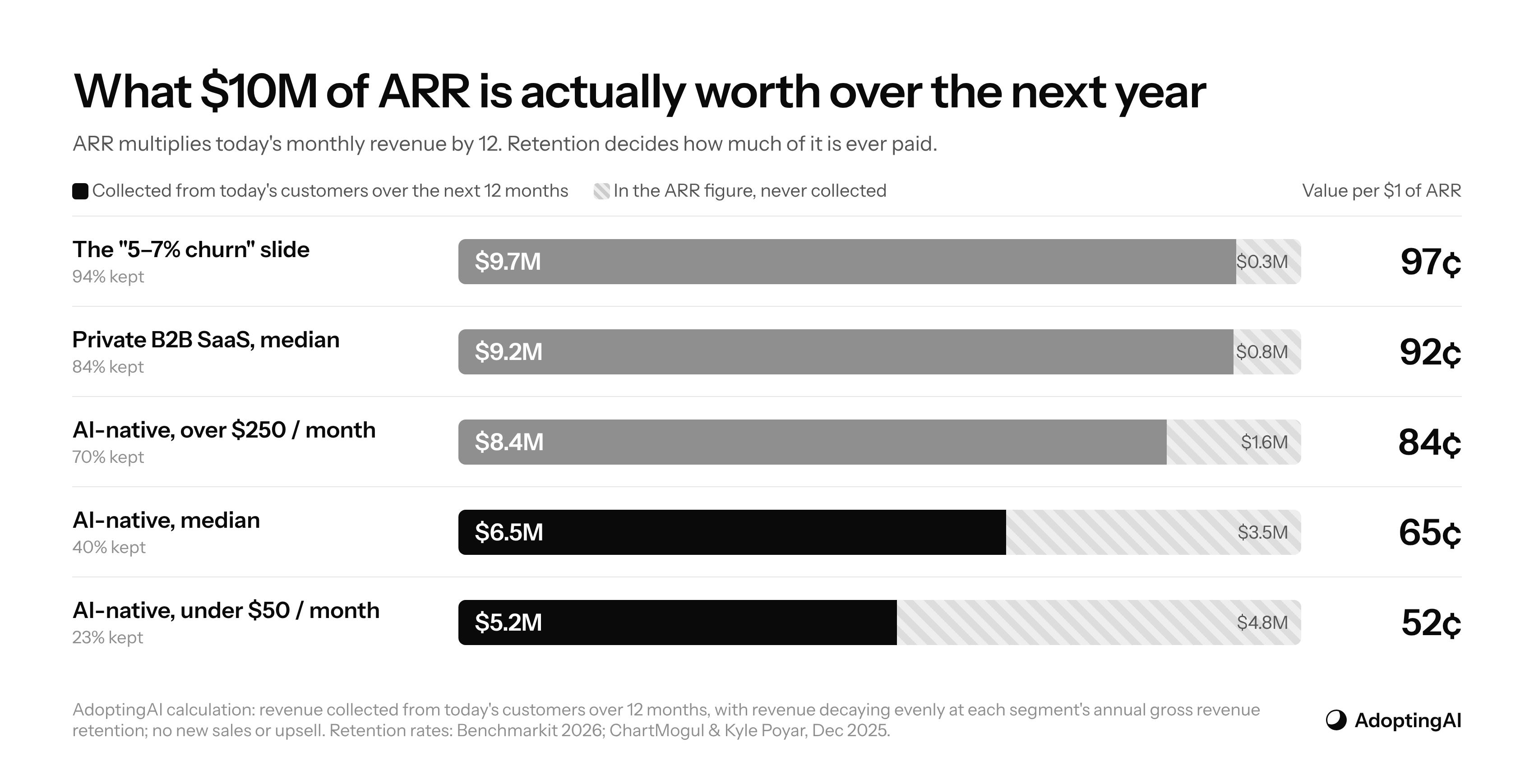
Valuation multiples are applied to the headline number. A 20x multiple on 65-cent dollars works out to roughly 30x on the dollars that actually arrive.
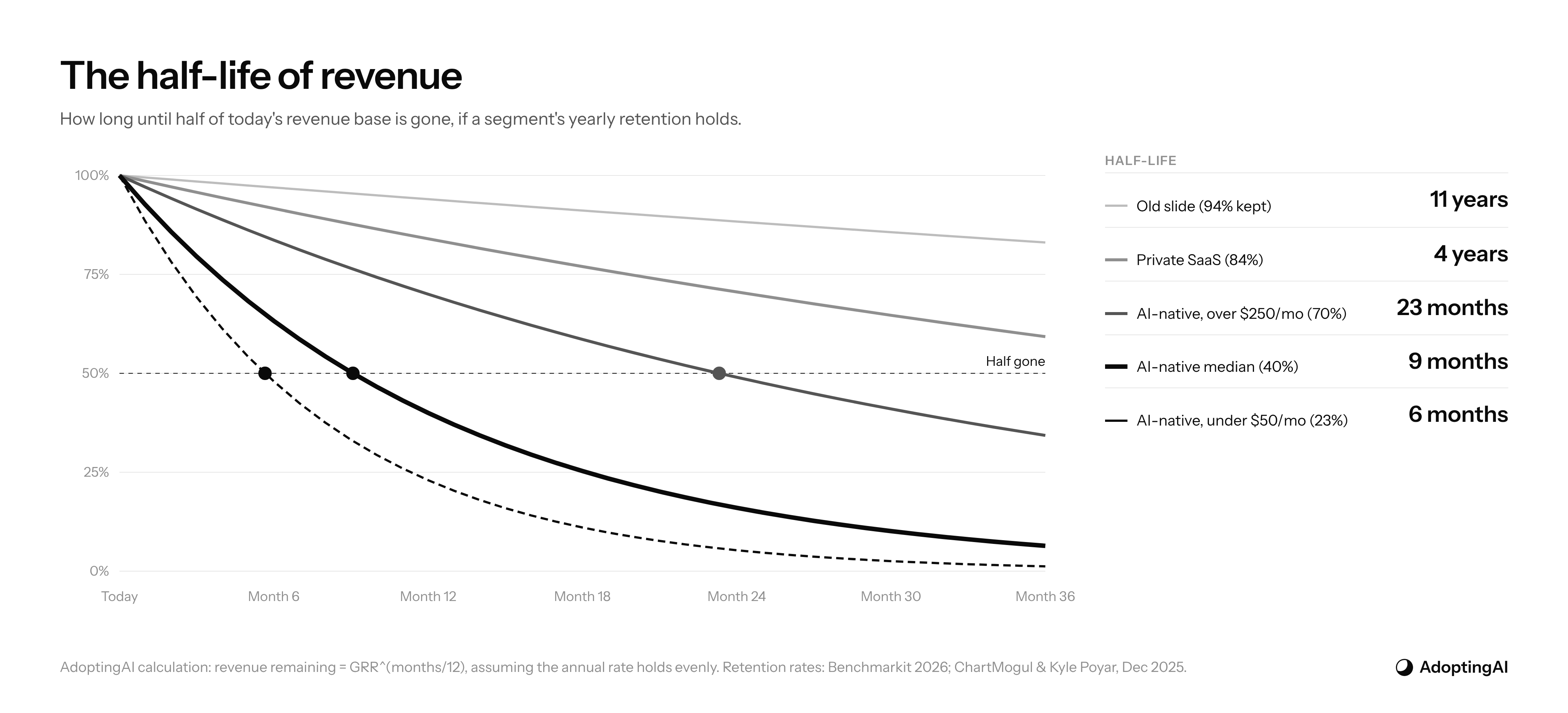
Seen another way, the median AI-native company loses half its revenue base in about 9 months. The median private SaaS company takes 4 years.
2. Customers aren't leaving AI. They're leaving vendors.
The usual reading of AI churn is that customers try AI and give up. Spend data says otherwise. In September 2026, 55.9% of US businesses paid for AI, up 12.1 points in a year (Ramp AI Index). The category is not losing customers.
What customers are not giving is loyalty. Ramp reports that 43.8% of US businesses pay Anthropic and 40.6% pay OpenAI. Those two shares add up to far more than the 55.9% paying for AI at all. That means at least 28.5% of businesses pay both: more than half of every business that pays for AI. In Ramp's token-spend sample, the two vendors' shares moved about 6 points in four weeks. In April, Ramp put it plainly: "the cost to switch between the models is minimal" (Ramp).
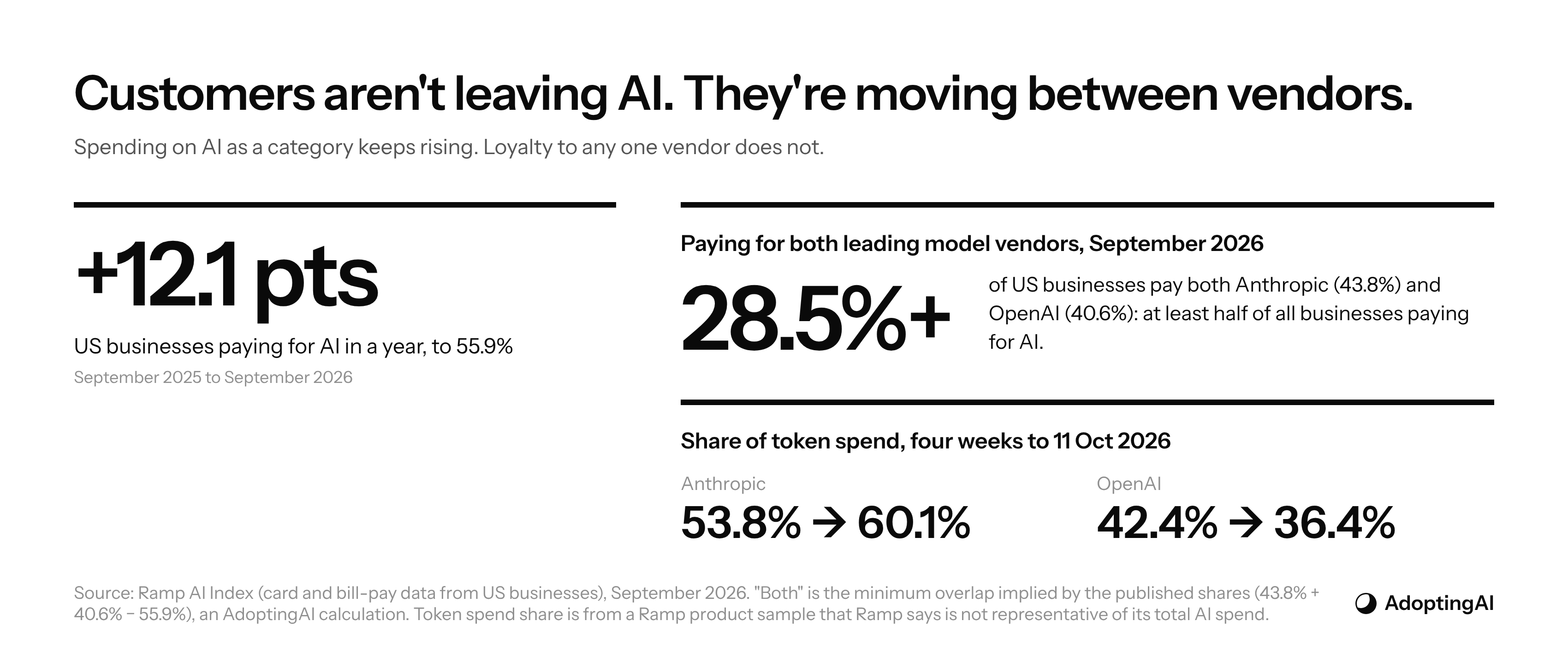
In SaaS, a company standardised on one vendor and stayed. In AI, many run two or more in parallel and move spend between them week by week. Part of every AI vendor's revenue is a share of a wallet that gets re-split every month.
3. Land-and-expand became land-and-land
The SaaS playbook was to land a small contract and grow it. In ChartMogul's data, AI-native net revenue retention (48%) is only 8 points above gross retention (40%). Upsell barely adds anything. Below $50 a month, expansion adds 9 points (23% to 32%). Above $250 a month, it adds 15 (70% to 85%).
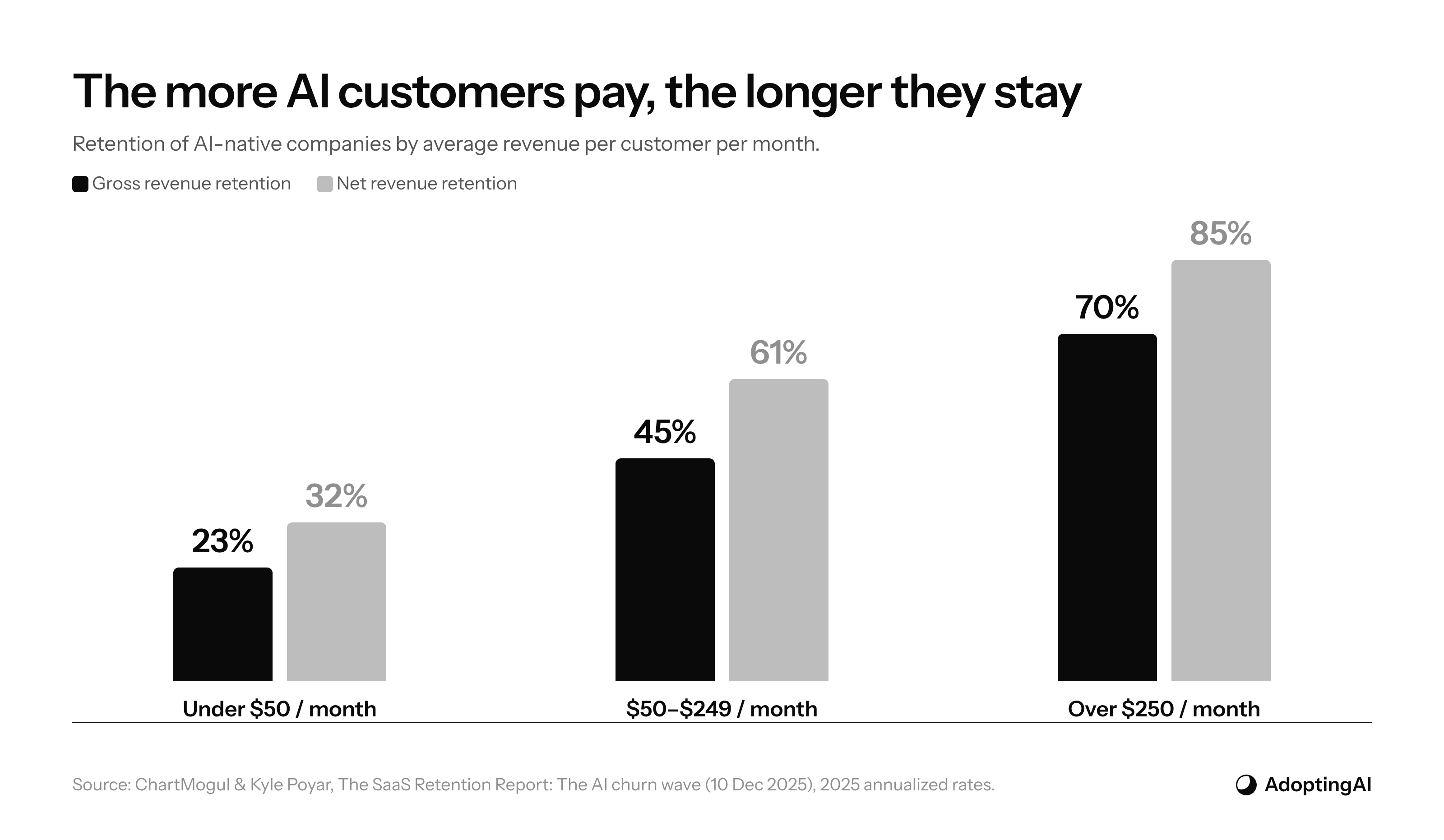
Without expansion, growth has to come almost entirely from new customers. Among low-retention AI companies, three times as many are shrinking as are growing quickly (Growth Unhinged). The fix companies are reaching for is commitment. Median net retention is 10–20 points higher on annual plans than on monthly ones, which is why Grammarly offers 60% off for paying annually.
Consumer apps show the same pattern. RevenueCat finds AI apps convert more trials to paid (8.5% vs 5.6%), but only 21.1% of annual subscribers are still paying after a year, against 30.7% for other apps (TechCrunch).
4. Nobody cancelled. Revenue still shrank.
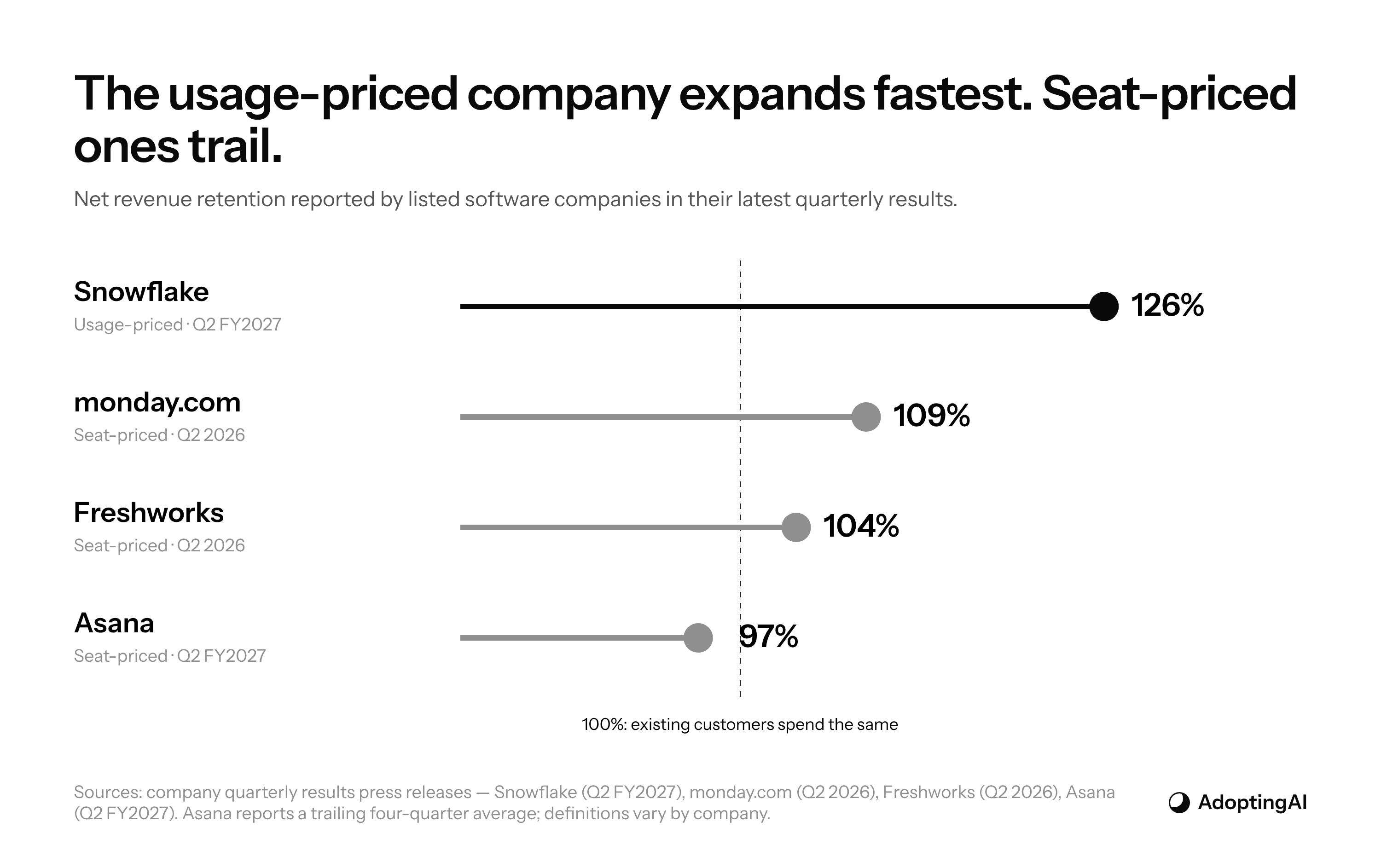
The "5–7% churn" slide counts customers who leave. In seat-priced software, the bigger loss now comes from customers who stay and buy fewer seats. Benchmarkit's 2026 report puts median net revenue retention at 98% for seat-priced private SaaS and 108% for usage-priced. Median GRR across private B2B SaaS fell from 88% to 84% in a year.
Listed companies show the same split. Asana, priced per seat, reported net revenue retention of 97%, although it says every cohort improved. Freshworks reported 104%, down from 106% a year earlier. monday.com reported 109%. Snowflake, priced on usage, reported 126%.
Investors moved first. Between 12 January and 23 February 2026, the S&P Software & Services Index fell 25%, on fears that AI agents would cut the number of seats companies need (The Batch).
What to measure instead
Investors and boards: ask for collectible revenue, not ARR: how much of today's revenue today's customers will actually pay over the next twelve months. Apply multiples to that figure. Ask for GRR by price tier and by cohort, not one blended number.
Founders: report your revenue half-life next to ARR. In accounts that use more than one AI vendor, track your share of the customer's AI spend. Measure retention from month 3, as a16z suggests, so trial users don't distort the curve. Sell annual plans.
CXOs and CFOs: you are already multi-vendor, so write contracts that let you move spend between vendors. At seat-based renewals, push for usage- or outcome-based pricing.
India's SaaS companies: many sell seat-priced software to global mid-market customers, the segment where shrinkage shows up first. Freshworks' slip from 106% to 104% net dollar retention is an early sign worth watching.
Methodology and sources
The 65-cent and half-life figures are our own arithmetic on published retention rates. They assume revenue decays evenly through the year, with no new sales or upsell. Real cohorts usually lose more in the first months, so the true collectible share may be lower. The 28.5% "pay both" figure is the minimum overlap implied by Ramp's published shares. The 30x multiple is an illustration, not a market observation. Each source uses its own sample and definitions, so figures are compared within each source. We did not run our own survey.
Not tested: whether AI-native retention keeps improving (ChartMogul saw median GRR rise from 27% to 40% during 2025); whether multi-vendor buying settles on one vendor as AI budgets mature; and how collectible revenue compares with reported ARR at specific companies.
- ChartMogul & Kyle Poyar, The SaaS Retention Report: The AI churn wave (December 2025) and Growth Unhinged analysis
- Ramp AI Index (September 2026) and April 2026 update
- Benchmarkit, 2026 B2B SaaS & AI-Native Metrics report
- RevenueCat, State of Subscription Apps 2026, via TechCrunch
- Andreessen Horowitz (a16z), AI retention benchmarks
- Forbes, Seed-stage AI startups are flashing record revenue numbers (April 2026)
- DeepLearning.AI, The Batch: SaaS stock sell-off
- Quarterly results: Snowflake Q2 FY2027, monday.com Q2 2026, Freshworks Q2 2026, Asana Q2 FY2027
AdoptingAI is a research newsletter by PanScience. Issue 04.