
A faster horse
Every company now says it is "adopting AI". That is the problem.
Adoption has become the goal in itself. Licences bought, copilots rolled out, usage dashboards turning green. But adoption measures whether people touch the tool. It does not measure whether the work has changed.
And mostly it hasn't. US Census Bureau data published in April 2026 shows that most firms using AI use it in three or fewer business functions, and that two-thirds use it only to help with tasks people already do. The tool is new. The process is the same.
That is what this issue is about, in one line:
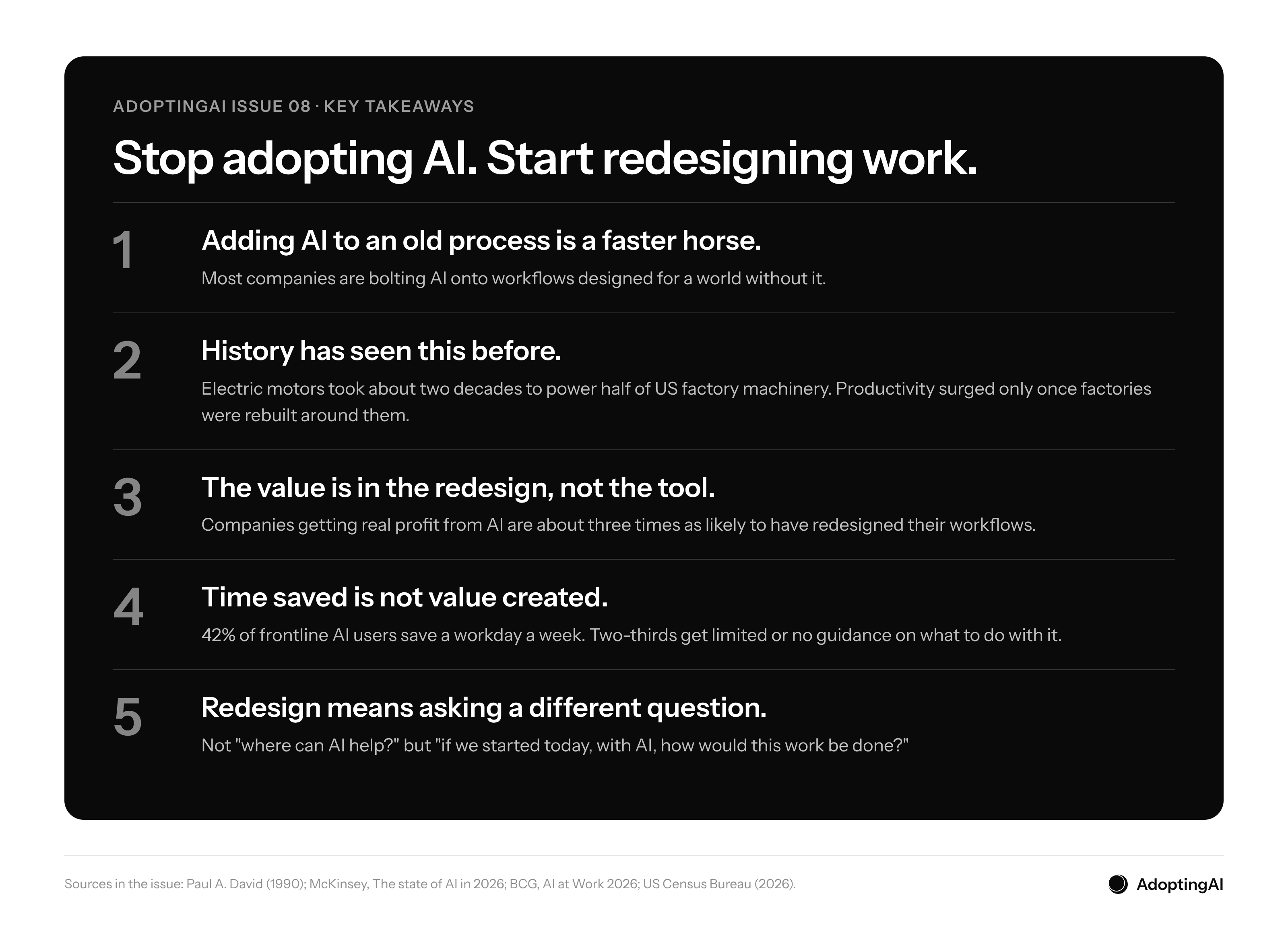
Adding AI to an old process is a faster horse.
We have seen this before. When electricity reached factories, productivity barely moved for decades. Then it surged, once factories were rebuilt around the electric motor instead of the steam-era layout. Economic historians have documented exactly how that happened. It is the most useful story a leader can know about AI right now, because it says the lag is not about the technology. It is about how long it takes to redesign the work.
The dynamo lesson
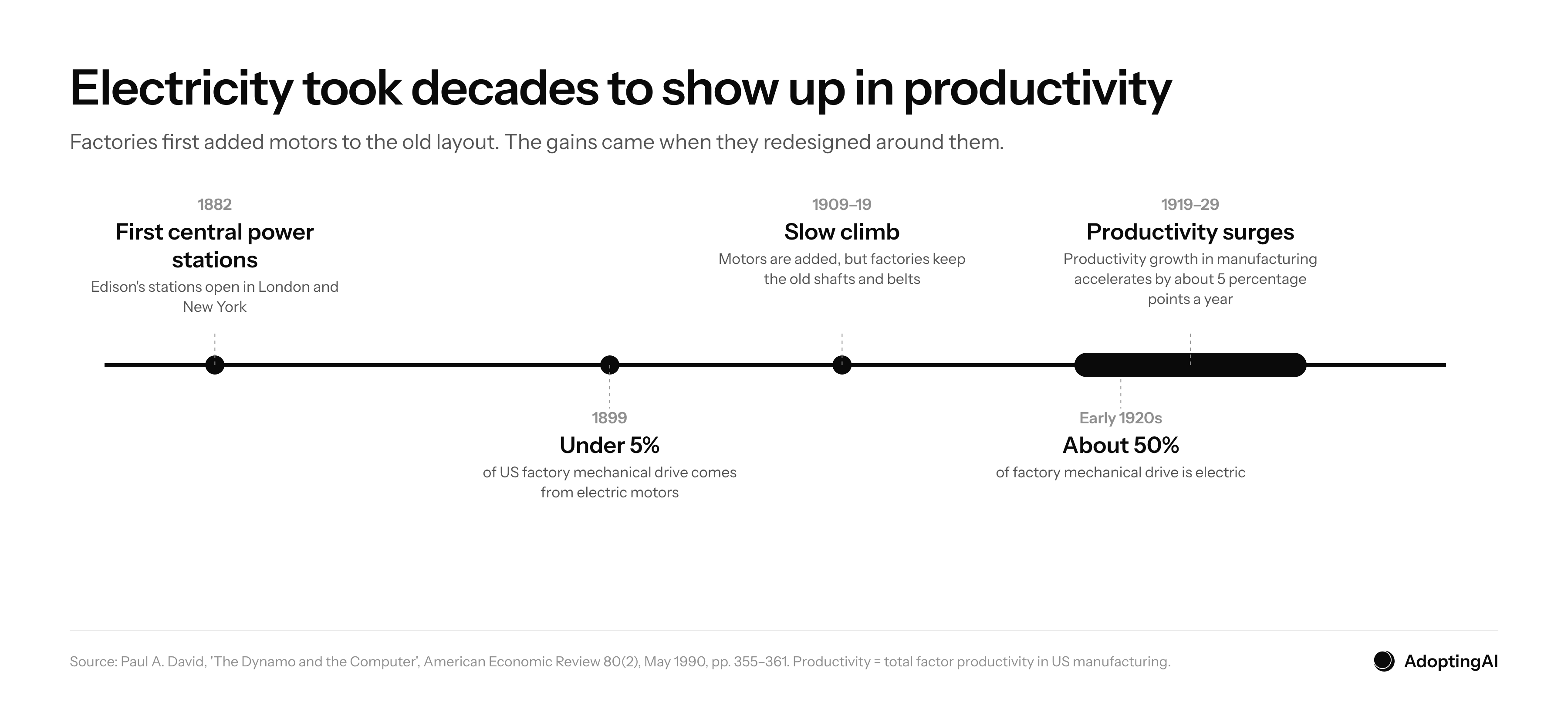
In 1987 the economist Robert Solow wrote a line that became famous: "We see the computers everywhere but in the productivity statistics." Three years later, the Stanford economic historian Paul David answered him with a paper called The Dynamo and the Computer. His point was simple. We have been here before, with electricity.
Edison's first central power stations opened in London and New York in 1882. By 1899, electric motors provided less than 5% of the mechanical drive in US factories. It was only in the early 1920s that just over half of factory drive was electric. And it was in the decade 1919–29 that the payoff finally arrived: David records a 5 percentage point acceleration in the growth of total factor productivity in US manufacturing.
Why so long? Not because the motors didn't work. Because of how factories first used them.
A steam-era factory was built around one engine. It turned a long shaft running the length of the building, and every machine took its power from that shaft through belts and pulleys. The early electric factory simply swapped the steam engine for a big electric motor. Same shaft, same belts, same multi-storey building arranged around the power source rather than the work.
The gains came with what engineers called unit drive: a small motor in each machine. No more shafts. Machines could be placed where the flow of work needed them. Factories became single-storey, lighter, easier to reconfigure. That took new buildings, new layouts, new skills and a new generation of managers. It took decades.
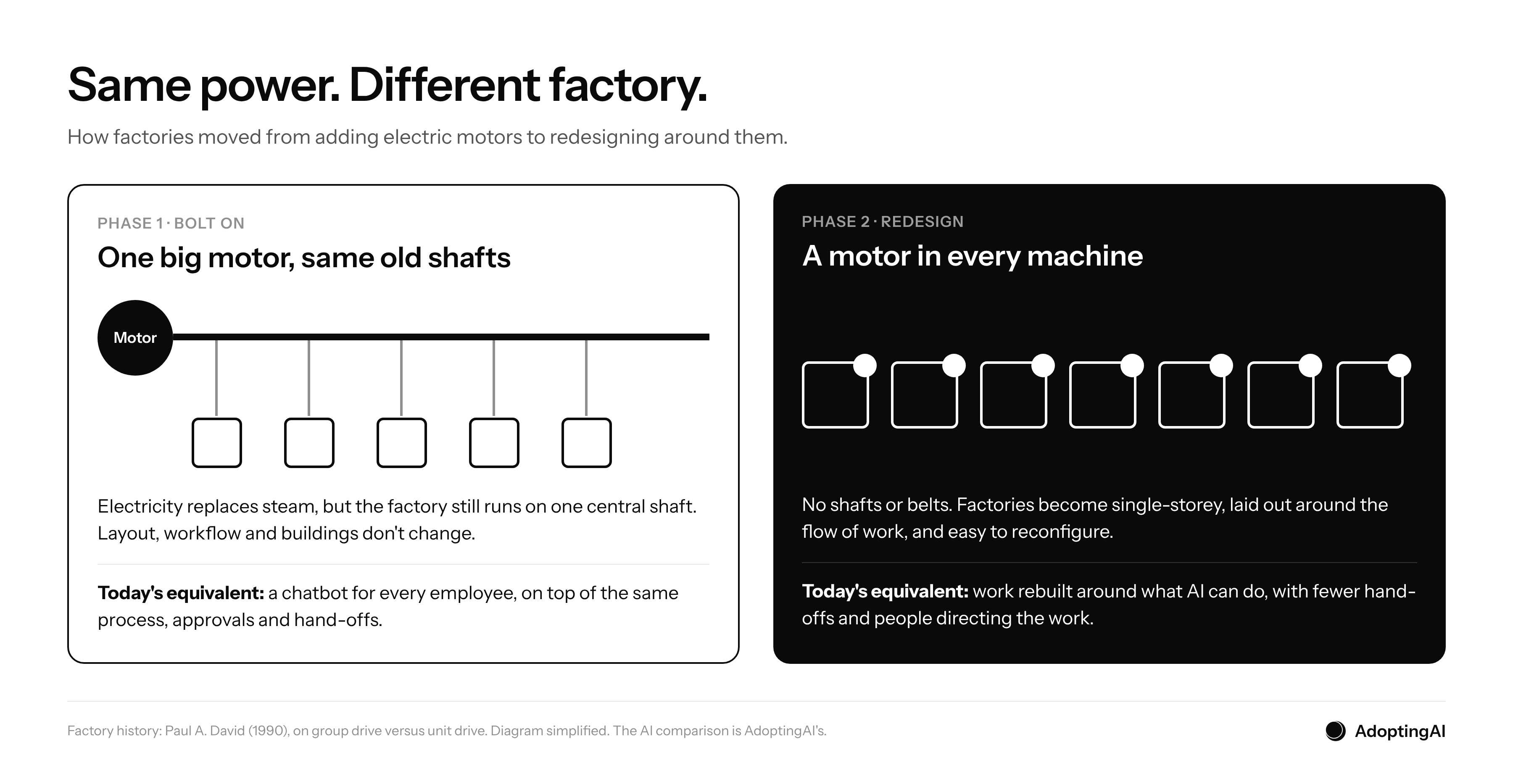
The technology was ready long before the organisations were. The electric motor didn't deliver the productivity. The redesigned factory did.
AI is in its line-shaft phase
The best evidence that we are bolting AI on comes from the US Census Bureau, which asks firms not just whether they use AI, but where and how. A working paper published in April 2026, covering November 2025 to January 2026, found:
- 18% of US firms used AI in a business function (32% weighted by employment).
- 57% of those firms use it in three or fewer business functions.
- 65% of firms where workers use AI limit it to three or fewer tasks.
- 66% of firms using AI use it only to augment tasks people already do.
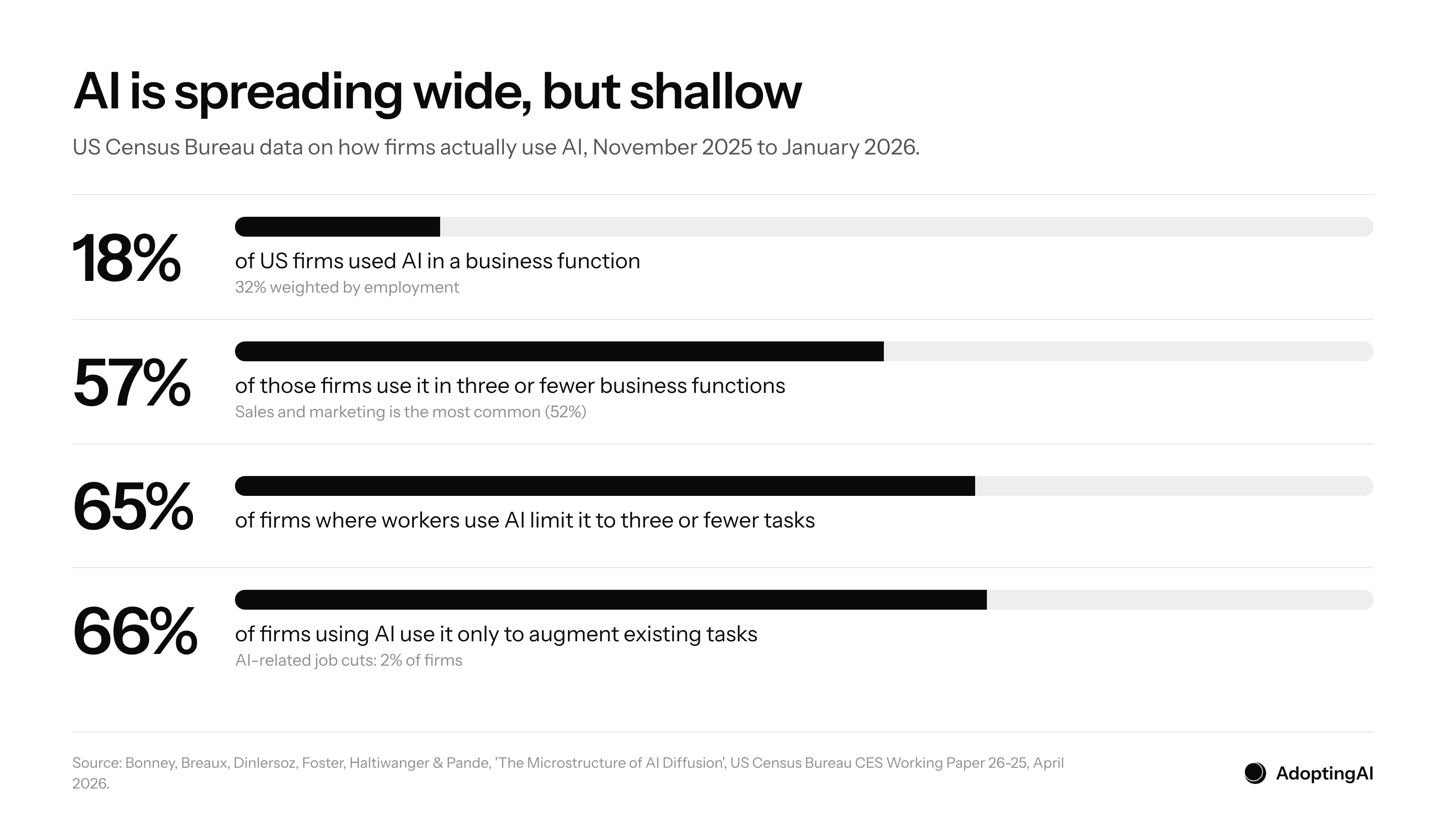
Read together, these describe the big motor on the old shaft. AI sits on top of a few tasks in a few functions, and the work around it is unchanged.
The pattern shows up in global surveys too. McKinsey's State of AI in 2026 survey finds that about nine in ten organisations use AI regularly in at least one function. But only 37% say AI has contributed anything to their EBIT, essentially unchanged from a year earlier. And only around 6% are what McKinsey calls high performers, attributing 5% or more of EBIT to AI.
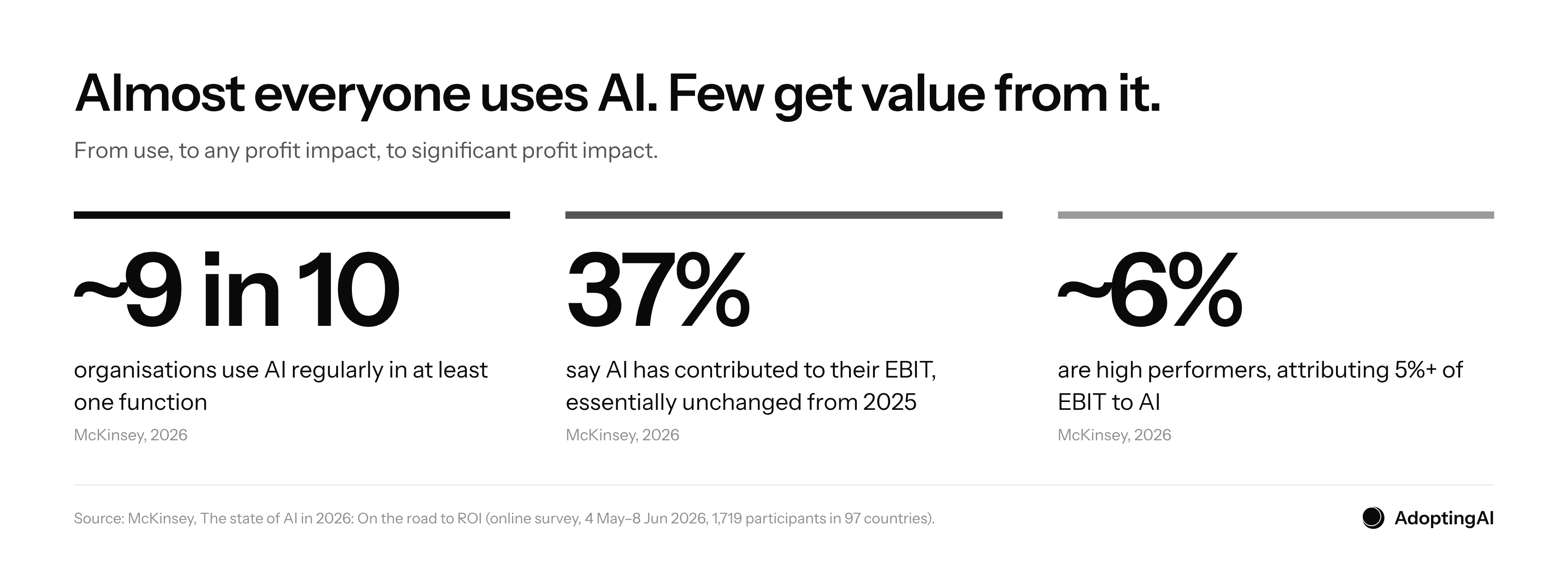
Use has nearly saturated. Value has not moved. That gap is the line shaft.
This is where a fresh look matters. The usual explanation for the gap is that the technology is not good enough yet, or that employees need more training. Both may be true. But the electricity story points somewhere else: the companies that will win are not the ones with the best AI. They are the ones that redraw the factory.
What redesign looks like
The data on who gets value from AI points in one direction. In McKinsey's 2026 survey, nearly three-quarters of high performers say they have fundamentally redesigned their workflows, against about a quarter of other companies. That is roughly three times as likely.
BCG's AI at Work 2026 survey, of more than 11,000 workers across 14 markets, shows the other side of the same coin. 42% of regular frontline AI users say they save at least a full workday a week. But 66% say they get limited or no guidance on what to do with that time. At companies pursuing workflow redesign, employees are 24 percentage points more likely to see measurable business improvement.
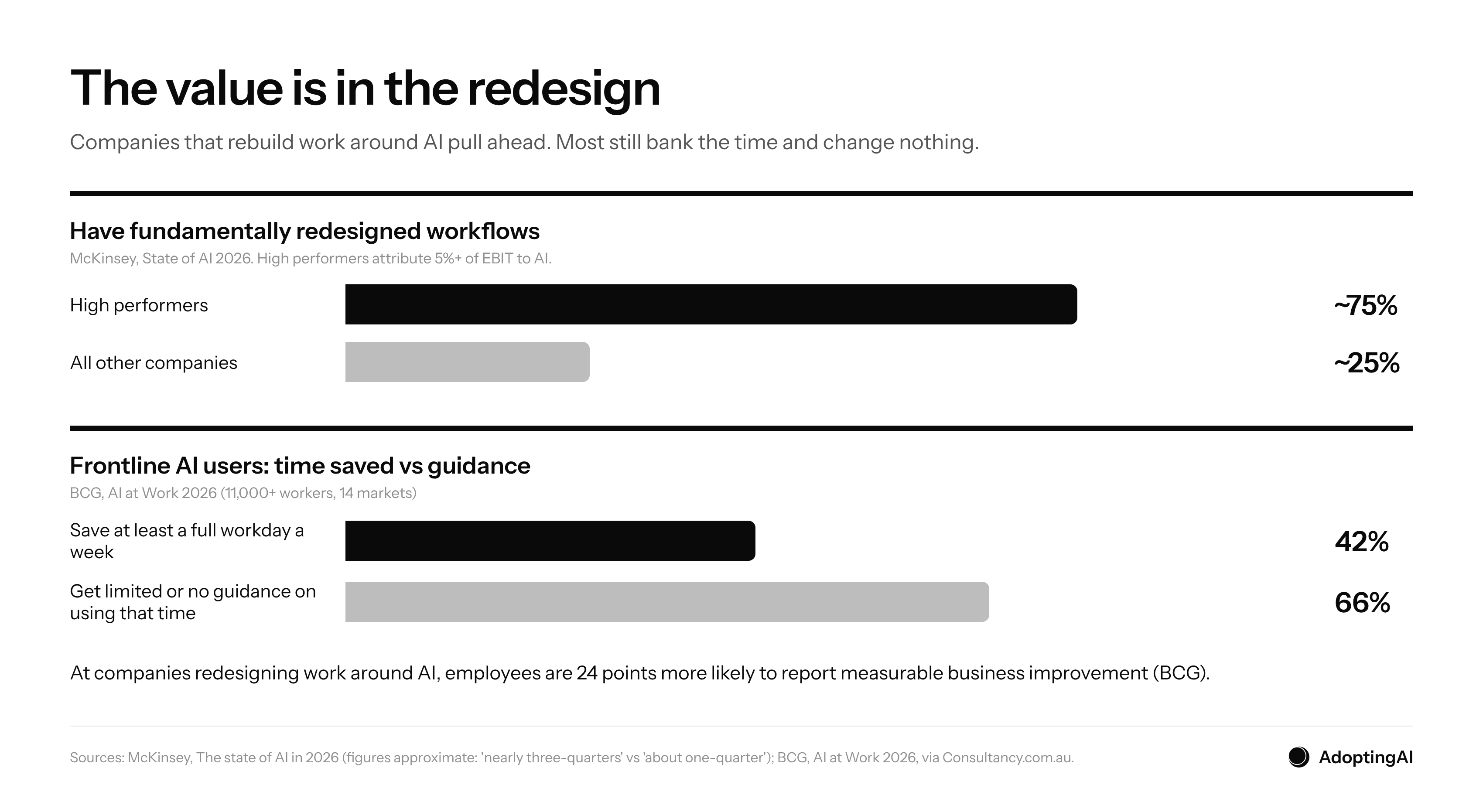
This is the most underrated number in AI adoption. A day saved per person per week is enormous. But if nobody has decided what that day is for, it disappears into email, meetings and slightly better slides. Time saved is not value created. Value comes when someone redraws the work so the saved time goes somewhere.
At AdoptingAI we find it useful to think of three stages:
- Bolt on. Add AI to tasks. Same process, same hand-offs, people write and search faster. This is where most companies are.
- Rewire. Redesign the workflow. Remove steps, merge roles, let AI do whole stages while people review and decide. This is where high performers are moving.
- Reinvent. Create work that wasn't possible before: new products, services and business models built on AI from day one.
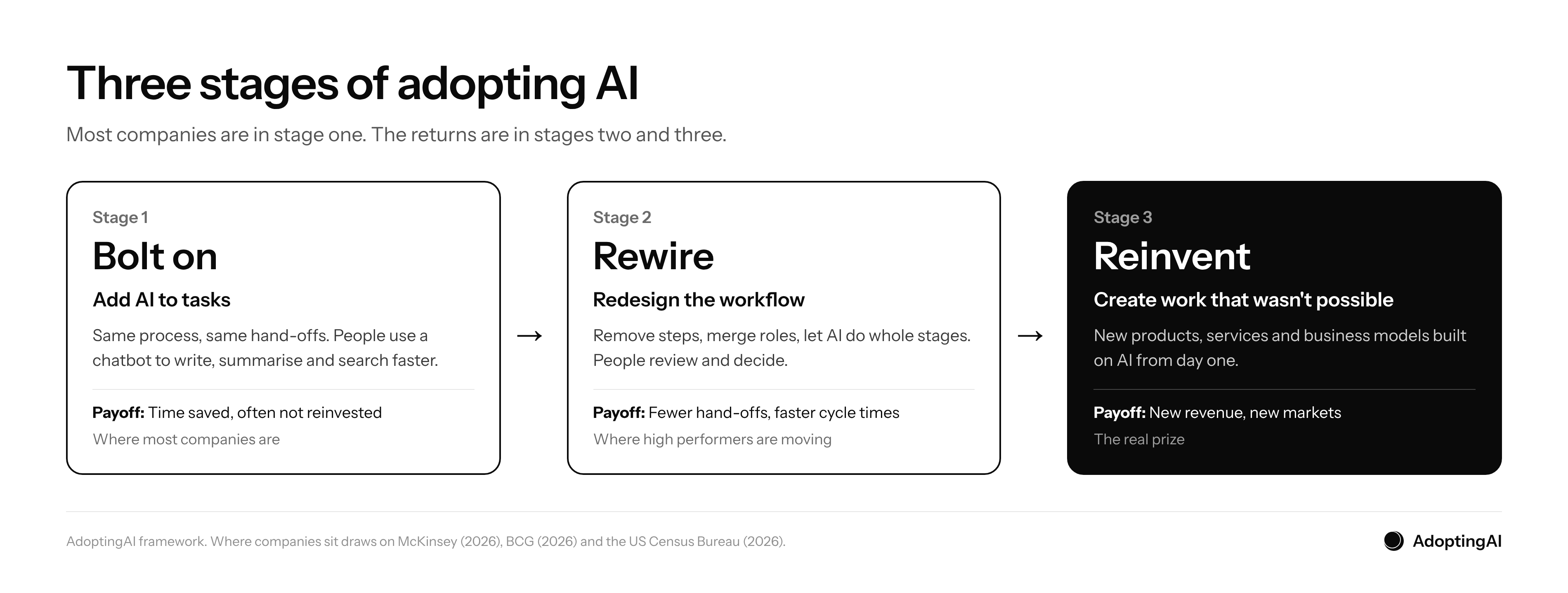
The factory parallel is direct. Bolt on is the big motor on the old shaft. Rewire is unit drive. Reinvent is what came after: new kinds of factories and products that the old layout could never have supported.
The test of which stage you are in is not how many people use AI. It is whether any process diagram in your company looks different from how it looked two years ago.
Why redesign is hard
If redesign is where the value is, why do so few companies do it? Two reasons, one in the accounts and one in the org chart.
The accounts. Erik Brynjolfsson, Daniel Rock and Chad Syverson call it the productivity J-curve. When a company adopts a general-purpose technology, it has to invest heavily in things that don't appear on a balance sheet: new processes, new skills, new data, new ways of managing. Those investments cost money and time now and pay off later. So in the early years, measured productivity can look flat or even worse. Later, once the intangible investment pays off, it looks better than it is.
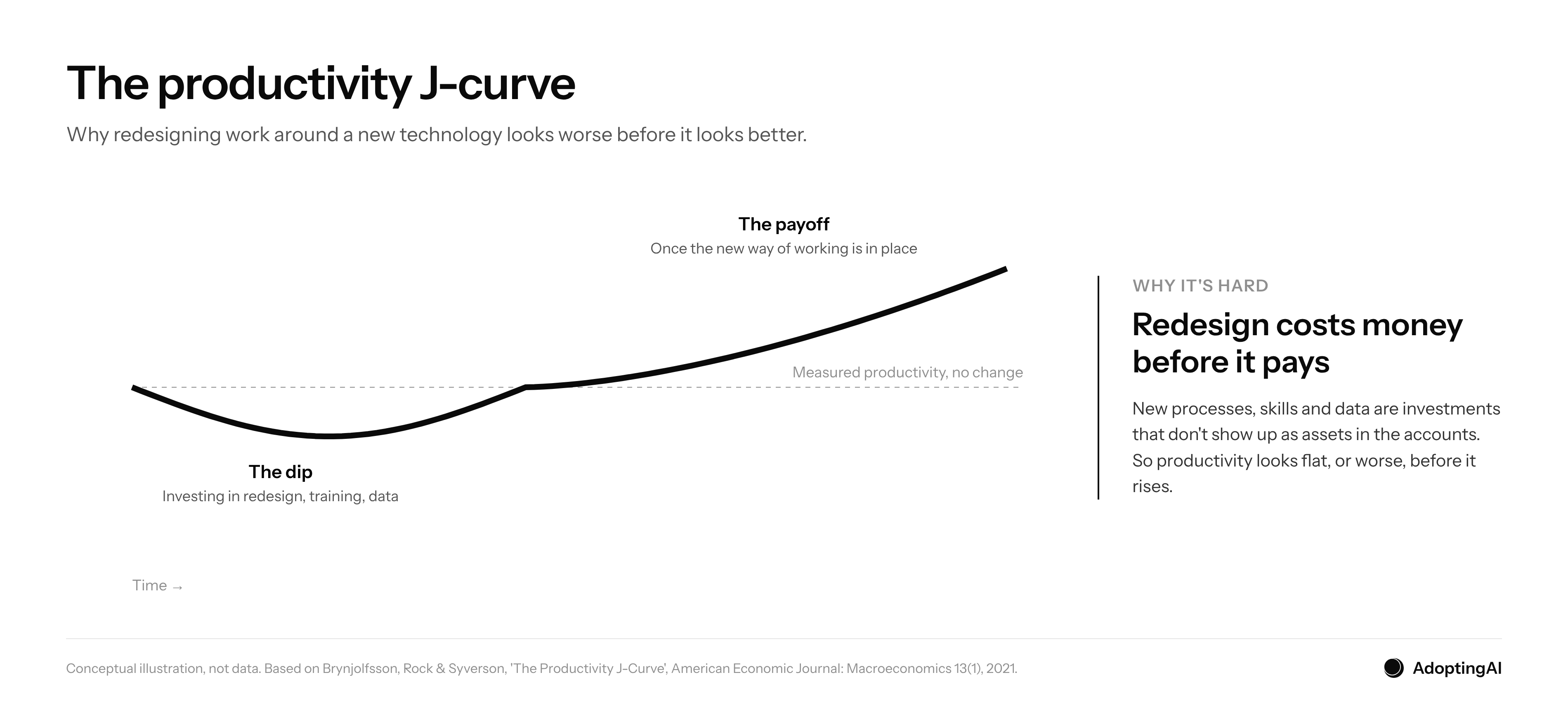
This matters for every board reviewing an AI budget. A bolt-on rollout looks good on a quarterly dashboard: usage up, hours saved, no disruption. A real redesign looks worse before it looks better. If leaders judge AI by the next quarter, they will keep rewarding the faster horse.
The org chart. Redesigning a workflow means crossing the lines that the current organisation is built on. An approval chain that AI makes unnecessary belongs to someone. A hand-off between two teams is two budgets and two managers. Bolting a tool onto each team's existing work asks nobody to give anything up. Redesign does. That is why it rarely starts at the team level, and why it needs someone senior enough to redraw the boundaries.
The factory owners of the 1900s faced the same problem. Their existing plants were built around shafts and belts, and it rarely made sense to rip them out before they wore out. Many of the gains came as new factories were built. Today's equivalent of the old plant is not a building. It is the process map, the job descriptions and the KPIs.
India's opportunity: skip the line shaft
There is one more lesson in the factory story. Much of the redesign happened not in old plants that were refitted, but in new plants built from scratch. Having less of the old layout to protect was an advantage.
India has played this game before, and won it twice.
It never put a landline in every home. It went mobile first. At the end of September 2026, TRAI counted 1,300 million wireless connections (including machine-to-machine) against 48.7 million wireline.
It didn't digitise the cheque. It built UPI, a new way to pay, and for everyday payments it moved far ahead of cards and cheques. In October 2026 alone, UPI processed 25.47 billion transactions.
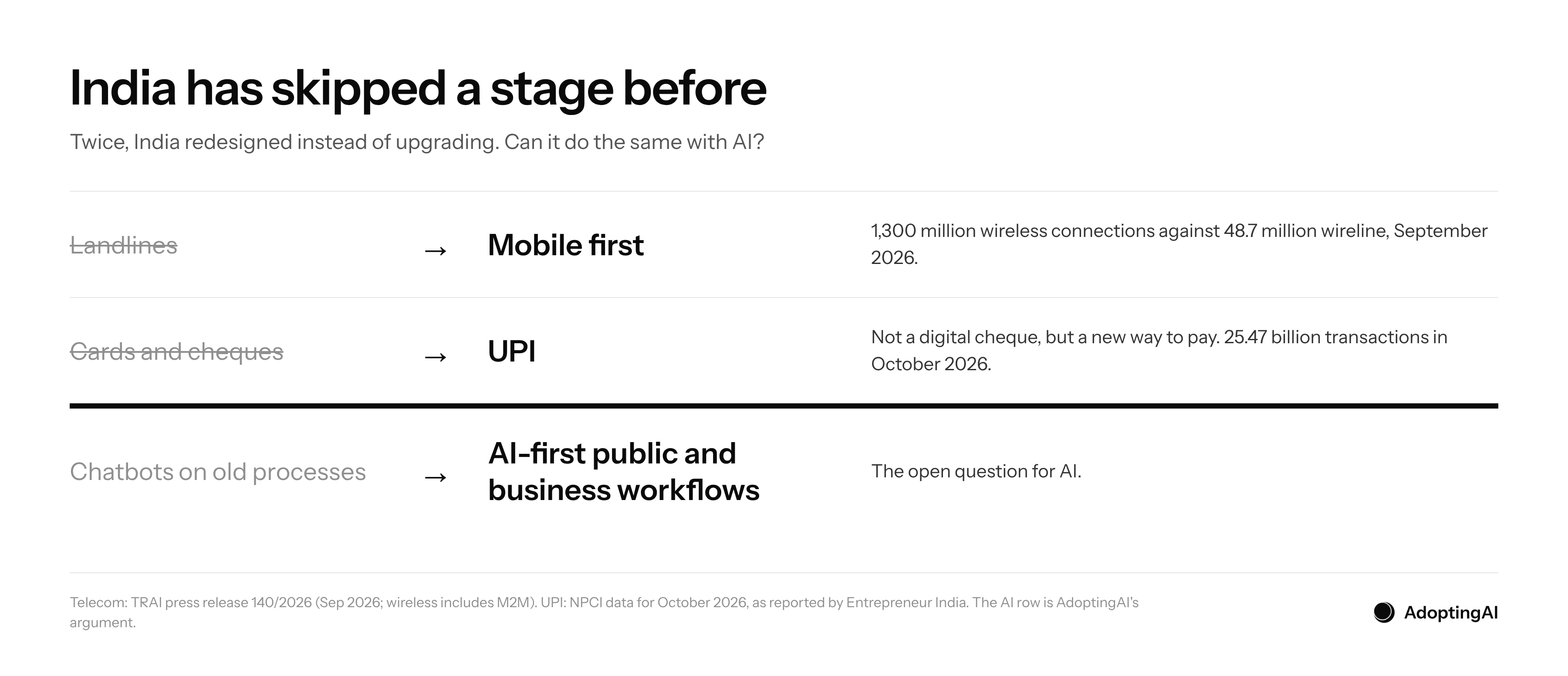
The question for AI is whether India does it a third time, or repeats the bolt-on mistake at national scale. The risk is easy to picture: a chatbot on every government portal and every SME's WhatsApp, with the same forms, the same approvals and the same paperwork behind it. That is a faster horse with an Indian accent.
The opportunity is the opposite. Large parts of the economy, from small manufacturers to state services, have not yet built heavy digital processes. They don't have a line shaft to protect. They can design work around AI from the start. That is a choice for founders and policymakers, not an automatic outcome.
What to do on Monday
The single most useful change is to replace the question leaders ask. Not "Where can AI help?" That question produces bolt-ons. Instead:
"If we started this work today, with AI, how would it be done?"
Then:
For CXOs
- Pick one end-to-end process, not one team. Claims, onboarding, procurement, month-end close. Redraw it from scratch with AI in it, and give one senior owner the authority to cross team lines.
- Stop reporting AI usage as success. Report what changed: steps removed, cycle time, cost per outcome, new revenue.
- Decide in advance where saved time goes. If 42% of regular frontline AI users are saving a day a week, that is capacity. Treat it like a budget.
- Give redesign a J-curve budget. Fund it for more than a quarter and expect the numbers to dip first.
For founders
- You have no line shaft. Don't build one. Design roles and processes around what AI can do now, rather than copying an incumbent's org chart and adding tools.
For policymakers
- Measure depth, not just use. The US Census Bureau now asks how many functions and tasks AI touches. Adoption surveys that only ask "do you use AI?" will tell a comforting and misleading story.
- Redesign public services, not just their front ends. A chatbot on a form is still a form.
The takeaway. The electric motor didn't make factories productive. The redesigned factory did. AI will be the same. The companies, and countries, that win this decade will not be the ones that adopted AI first. They will be the ones that redesigned work first.
Methodology and sources
What is tested and what is not. Every figure in this issue comes from the sources below. The three-stage framework, the comparisons between factories and AI, and the views on India are AdoptingAI's argument, not findings from the data. The J-curve chart is a conceptual illustration, not data. McKinsey's redesign figures are given as "nearly three-quarters" and "about one-quarter" in the report, so the chart shows them as approximate. Surveys cited here measure what respondents report, not audited results.
On the timing. The often-quoted "30 years" for electricity is a rounding. In David's data, electric motors went from under 5% of factory drive in 1899 to just over half in the early 1920s, and the productivity surge came in 1919–29, about four decades after the first central power stations.
On the faster horse. The line "If I had asked people what they wanted, they would have said faster horses" is widely attributed to Henry Ford, but there is no evidence he said it. We use "a faster horse" as our own line.
Sources
- Paul A. David, "The Dynamo and the Computer: An Historical Perspective on the Modern Productivity Paradox", American Economic Review 80(2), May 1990, pp. 355–361. PDF
- Robert M. Solow, "We'd better watch out", New York Times Book Review, 12 July 1987 (quoted in David, 1990).
- Bonney, Breaux, Dinlersoz, Foster, Haltiwanger and Pande, "The Microstructure of AI Diffusion: Evidence from Firms, Business Functions, and Worker Tasks", US Census Bureau CES Working Paper 26-25, April 2026. Link
- McKinsey & Company, The state of AI in 2026, online survey, 4 May–8 June 2026, 1,719 participants in 97 countries. Link
- BCG, AI at Work 2026, survey of more than 11,000 workers in 14 markets, as reported by Consultancy.com.au, 27 July 2026. Link
- Erik Brynjolfsson, Daniel Rock and Chad Syverson, "The Productivity J-Curve: How Intangibles Complement General Purpose Technologies", American Economic Journal: Macroeconomics 13(1), 2021. Link
- TRAI, Press Release No. 140/2026, Telecom Subscription Data as on 30 September 2026. PDF
- NPCI data for October 2026, as reported by Entrepreneur India. Link
- Quote Investigator, "My Customers Would Have Asked For a Faster Horse", 28 July 2011. Link
AdoptingAI is a research newsletter by PanScience.